OpenStreetMap logo OpenStreetMap

Users' Diaries

Recent diary entries

Mentre scarico alcuni dati dal geoportale della Regione Lombardia, guardo gli ultimi nodi mappati e noto che molti di questi sono defibrillatori.

Ma perché?

Direi che è iniziato per caso, quando ne sono stati aggiunti alcuni nel campus universitario che frequento. Il senso però lo trovo qualche tempo dopo, quando alla festa di laurea di una delle mie migliori amiche la zia della festeggiata - cardiologa - mi fa giustamente notare che durante le emergenze, quando la velocità conta, è meglio sapere dove sono piuttosto che non saperlo affatto.

E questa cosa mi fa riflettere, mi risuona ininterrottamente nella testa, soprattutto se consideriamo l’attività di mapping non solo come “raccolta di dati georiferiti” ma anche come possibilità concreta di migliorare (e talvolta salvare) la vita delle persone intorno a noi.

Da allora, anche aiutandomi con MapComplete che in questo caso mi risulta utilissima, mappo tutti i defibrillatori che mi passano davanti agli occhi. Anche allungando i tempi di viaggio per fermarmi a quella fermata che mai avrei frequentato (dai, chi scende a Caiazzo?), anche per confermare lo stato di quelli esistenti.

Avrà effettivamente dei risvolti positivi sulla vita delle persone? Chi lo sa. Intanto ci proviamo.

quelli che ho mappato

l’andamento a Milano

l’andamento nella Città Metropolitana

Location: Cerchia dei Navigli, Municipio 1, Milano, Rodano, Milano, Lombardia, Italia
Posted by Natfoot on 8 March 2026 in English. Last updated on 9 March 2026.

Rail trails with route relations with railway=abandoned to denote a rail trail is not working. When the named “bike route” enters city streets or along side walks where the railroad never went this becomes and tagging nightmare.

I have had to remove railway=abandoned from a route relation in British Columbia and in New Hampshire where these were both issues. osm.org/note/5066887#map=15/41.40203/-73.62096

osm.org/note/4680502#map=15/49.49511/-121.22581

Can we find a better tags to mark bike routes with rail trail?
this is specific to route relations and not current tags for infrastructure, railway=abandoned still works for infrastructure

I would propose something like railway=trail so we keep this straight. It looks like railtrail=yes is a tag.

Yours in Mapping Natfoot

this is related to my other project on routing and bike routes. ask if you want to know more.

Posted by SimonPoole on 8 March 2026 in English. Last updated on 25 March 2026.

This is not about the Linux Foundations Overture Maps attempt to hoodwink the Open Geospatial Consortium into standardising Overtures GERS (Global Entity Reference System) 1. There is so little technical content available in that proposal that it is difficult to write even a short paragraph about it. But it is motivated by Overtures attempt to engage in the great American tradition of selling snake oil by suggesting that GERS solves real problems 2. None of the following is new, and all this has been discussed many times in the OSM community.

It isn’t as if having a persistent id for an entity isn’t useful, for example if you are running a restaurant review site3 you definitely want a way to reference and track the state of the object you have reviews for in your geodata source, be it be based on OSM or some other data. The issue is simply:

your persistent id is not my persistent id.

Or perhaps better, your persistence is not my persistence. Lets illustrate that with the restaurant review example again: assume you’ve generated an id in some fashion and map that to an OSM object (more on that below), when do you consider the current restaurant different from the original, and when do you consider it different enough that you will want a new id?

Is it

  • when the name changes?
  • when the location changes? What about if it has just moved to the next block?
  • when the cuisine changes?
  • when the chef changes?
  • when the owner changes?

And so on.

The answers to these questions depend on your use case and your business logic and a global one size fits all is very unlikely to be of any help at all. Now you might say, but there are objects, places, buildings and geographical entities that have less tendency to change, at least on a typical humans time scale and yes ids could be useful for these, but they are by their very nature easily referenced by their location4.

See full entry

Posted by rphyrin on 8 March 2026 in English.

Today I received an invitation to attend the bi-monthly OSM US Maintainers Working Group.

But due to timezone difficulties, I don’t think I’ll be able to attend it live.

The meeting agenda has been shared, mainly focusing on the topic of standards and interoperability. There are some interesting starter questions there, so I’m intrigued to answer those questions in an OSM diary instead, hoping that I’ll be able to join the discussion asynchronously.

So, here we go :


“What standards (geospatial file or data formats, metadata schemas, wire protocols, structured text formats, encodings, etc.) does your project depend on or interact with?”

I frequently use GeoJSON format in several of my projects.

“Are there any standards that you wish would be evolved/extended but aren’t actively maintained? Or implementations that aren’t fully compliant that you wish would be?”

GeoJSON fits pretty much all of my required use cases. My only concern right now is how to make GeoJSON files more compact. I haven’t researched much about this since there’s currently no urgent performance issue that needs to be handled, but I love tweaking my apps for performance.

“Are there standard formats or protocols that you would like to use, but aren’t well supported in your language/ecosystem?”

The General Transit Feed Specification.

I’ve been interested in this data format for a long time, but I still don’t know how to properly tinker with it. Last time I worked on this, I had to make my own Python implementation to read and navigate GTFS files. I don’t know what the current situation is right now. Maybe it’s already supported, maybe not.

“What are your thoughts on Overture’s OGC proposal?”

I already posted my thoughts in a certain Slack thread somewhere. Here’s the verbatim quote:

“Does an OGC standard become legally binding worldwide or something?

See full entry

Posted by pussreboots on 8 March 2026 in English.

Tonight I finished mapping Maud, meaning the bulk of Fairview California is mapped. There are still some places along Fairview Avenue as it goes around in a circle and becomes Hayward but this is area shared by Hayward, Castro Valley and Fairview.

It feels so good to see my home there and recognizable.

I started this project in earnest on November 18th (although I did my own street back in June).

Location: Fairview, Alameda County, California, 94542, United States

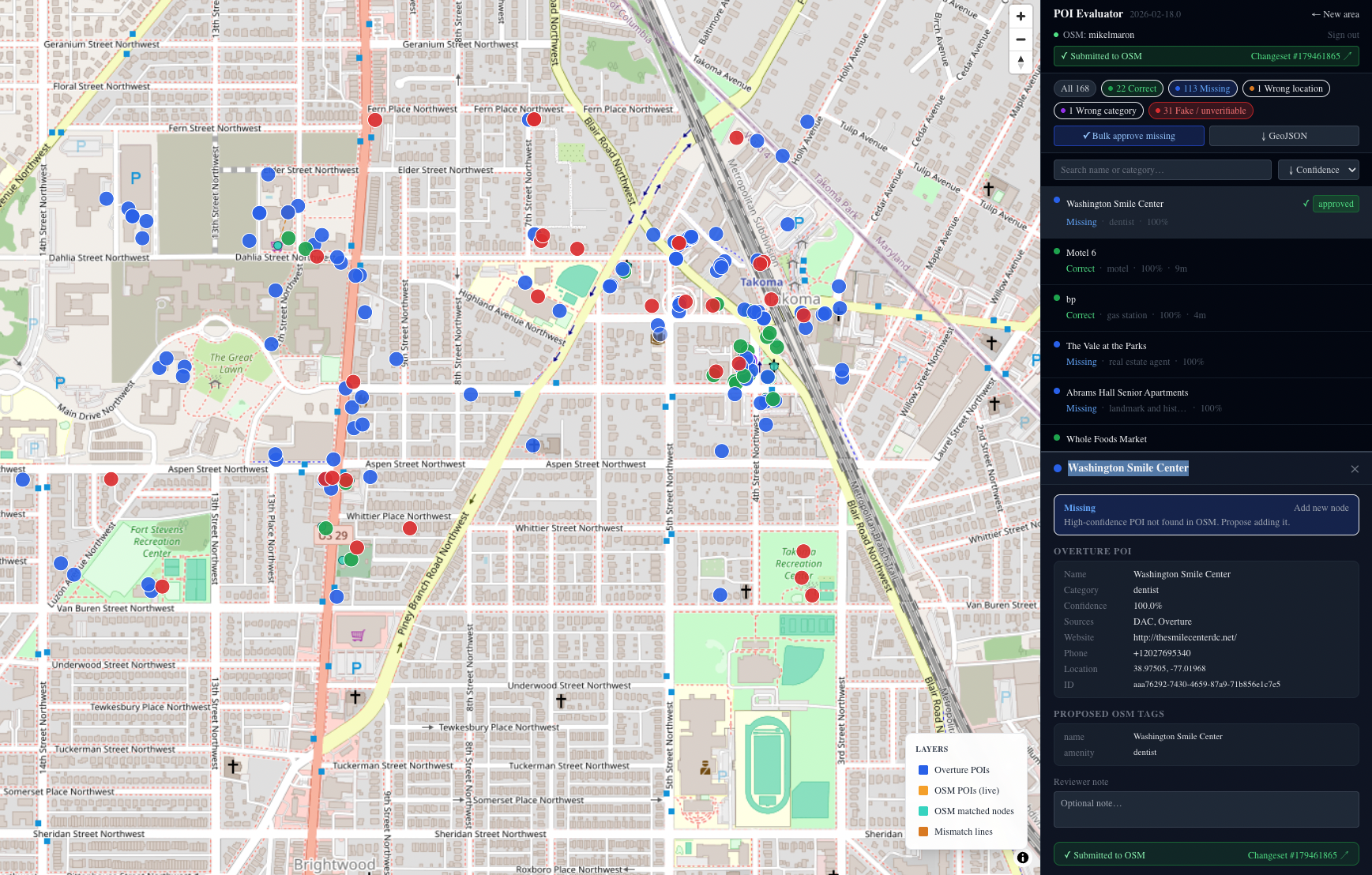
From the Build Plan developed with Claude

Project Purpose A web application enabling mappers and data quality analysts to select a geographic area, fetch Overture Maps POI data and OpenStreetMap data in parallel, algorithmically compare them, and produce two outputs: a reviewed, selective upload to OSM via OAuth2, and an annotated GeoJSON export classifying each Overture POI by assessment category.

No edits to OSM happen without manual review. Overture is more of an attention guide (at least that’s my hypothesis)

Here’s the chat

Lots of UX fine tuning to come. Quick observations:

  • Overture is very noisy, lots that is irrelevant (business mailing addresses in personal houses, mislocated POIs, closed places, duplications with differences across Meta/Microsoft/4SQ sources)
  • Matching is hard but can be improved
  • There is useful signal in Overture, places that need addition to OSM in new developments, but you have to have means to easily sort through and keep a record.

See full entry

In May 2025 the OSM website introduced two new optional fields in user profiles: company and location. I recently analyzed whether these fields could be useful for detecting organized (paid) editing accounts for my How Did You Contribute (HDYC) pages. Short summary:

  • Around 66k active user profiles analyzed
  • About 1,000 unique company entries
  • About 2,200 location values

Interestingly, large companies such as Apple, Amazon, or Meta still mostly appear in the profile description, not in the dedicated company field. I wrote a more detailed blog post here.

While working on this analysis I also added username history to HDYC, derived from the full changeset replication history. I am not fully happy with the current presentation and would appreciate feedback:

  1. Move the username section further down?
  2. Add a time-based filter (e.g. last 5–10 years)?
  3. Remove it.
Location: 0.000, 0.000

Until recently, I mainly used the opening_hours evaluation tool to quickly generate valid OSM opening hours. However, it often requires some manual work to simplify the syntax afterwards.

That’s why I tried using ChatGPT instead - and it works surprisingly well. You can simply copy and paste opening hours from websites, or even upload an image, and ask it to format them for the opening_hours tag.

Example

Scapino opening hours, Winschoten

LLM query

please format the opening hours in the attached image for the OSM 'opening_hours' tag.

Output

Mo 13:00-18:00; Tu-Th 09:30-18:00; Fr 09:30-21:00; Sa 09:00-17:00; Su off

This is a rather simple example, but it also works well with more complex opening hours.

Taking info from

https://www.rigacci.org/wiki/doku.php/doc/appunti/hardware/gps_logger_i_blue_747

and

https://www.technologyblog.de/2019/05/gps-rollover-zerstoert-gps-logger/

and

https://wiki.openstreetmap.org/wiki/Holux_M-241

a modified mtkbabel can set the time when reading from the device. That should probably go into some check whether it’s really a M-241 that is connected, but as long as the battery lasts the device shows the correct time again and logs tracks in this year and not dated 2006..

$ diff -u /usr/bin/mtkbabel ./mtkbabel
--- /usr/bin/mtkbabel   2019-10-12 12:23:29.000000000 +0200
+++ ./mtkbabel  2026-03-03 19:37:37.482923895 +0100
@@ -166,7 +166,7 @@
 #-------------------------------------------------------------------------
 my $debug    = $LOG_WARNING;     # Default loggin level.
 my $port     = '/dev/ttyUSB0';   # Default communication port.
-my $baudrate = 115200;           # Default port speed.
+my $baudrate = 38400;           # Default port speed.
 my $ro_weeks = 0;                # Weeks offset to fix Weeks Rollover Bug

 # GPX global values.
@@ -356,6 +356,18 @@
     set_data_types($model_id);
 }

+# Set time to work around week rollover bug
+
+my ($sec,$min,$hour,$mday,$mon,$year) = gmtime;
+
+$year += 1900;      # year is years since 1900
+$mon  += 1;         # month is 0-11
+
+packet_send(sprintf('PMTK335,%04d,%02d,%02d,%02d,%02d,%02d', $year, $mon, $mday, $hour, $min, $sec));
+$ret = packet_wait('PMTK001');
+printf "Set time string: $year, $mon, $mday, $hour, $min, $sec\n";
+printf "Return for setting time: $ret\n";
+
 #-------------------------------------------------------------------------
 # Erase memory.
 #------------------------------------------------------------------------- 

I have created a tag, diet:excipient_free=* , which is about finding clean supplements, i.e., without harmful ingredients that can make us infertile, inflamed, obese or even epileptic.

For example, whenever we look for magnesium (bis)glycinate, we want one thing, but many so-called “magnesium” supplements come with a lot more ingredients that might reduce the price, or enhance the appearance, but of course, at a cost; to hurt and make us need another supplement to compensate with the side effects. (Maybe they should rename those “magnesium” supplements to corn syrup supplements instead.)

Almost if not all of those ingredients fall into one category, excipients. Let’s use diet:excipient_free=* on pharmacies and nutrition supplement stores to promote a healthier future without dyes, fillers, flavorants, preservatives and other inactive ingredients that can cost us our health.

🌳 Percebendo que havia poucas informações no OpenStreetMap sobre o Parque Evaldo Cruz, em Campina Grande - PB, iniciei há uns meses o micromapeamento da área motivado pela reforma que ocorreu no local, por ser uma área verde que frequento cotidianamente e ser parte do Parque do Povo, onde acontece o Maior São João do Mundo.

Folha de Handroanthus impetiginosus Identificação em campo de Handroanthus impetiginosus (Ipê-roxo-de-bola)

📚 Sou pesquisador da área ambiental então sempre tento mostrar o potencial que o mapeamento para o OpenStreetMap possui. Os resultados abaixo são relacionados às árvores mapeadas e identificadas no local do parque, um trabalho que iniciei faz mais de seis meses e está quase 100% pronto. Quem quiser acompanhar esses e outros mapeamentos, costumo divulgá-los no Instagram - OMapaPB.

See full entry

Location: Centro, Campina Grande, Paraíba, Região Nordeste, Brasil
Posted by SimonPoole on 4 March 2026 in English. Last updated on 6 March 2026.

OpenStreetMap old timers know about the infamous 2009 TIGER import of road data in the US that continues giving to this day. Our story has none of the, maybe deliberate, shenanigans (see the TIGER improvement project) that went on back then in the US, but there are clearly some similarities in the lessons that should be learnt.

Back in July of 2011 the Swiss community undertook a big effort to import municipality boundaries from swisstopo (the marketing name of the federal Swiss GIS department) (see osm.wiki/Switzerland/swissBOUNDARIES3D). Being an OSM n00b at the time with just a bit over a year editing experience I didn’t really do anything useful for the import proper, but I did organise the explicit permission needed from swisstopo as this was many years before their data would become available for use on open terms for us in September 2021. With a couple of technical hiccups along the way that are not really documented, we finally managed to complete the work by early August.

Fast forward to today: I’ve been going on for a few years now that we really need a quality assurance process so that we can discover and track differences between swisstopos data and what is in OSM. We knew and fully expected that there would be differences, because:

  • at the time of the import we simplified the boundaries quite significantly because of the resource constraints of the computer hardware available to us,
  • over the last 14 years we independently followed the mergers and other changes of the municipalities (see osm.wiki/Switzerland/2026_Municipality_Mergers), and didn’t expect this to improve the accuracy of the boundaries, and we knew that now and then there would be associated minor geometry changes that we wouldn’t be able to track,
  • and then just general decay due to glueing and accidental modifications.

Thanks to work by our community member habi inspired by earlier work by Branko Kokanović from Serbia, we have now have daily QA data and boy, we were wrong.

See full entry

Привет сообществу OpenStreetMap!

Не знаю, будет кто-то читать эту запись или нет, но попробовать написать в дневник — очень интересный опыт. Нигде не слышал, что здесь есть такой функционал, а раз имеется 😊 — нужно пользоваться.

В этой записи я хотел бы поделиться своим первым опытом. По сути, этот текст будет «водой» и не принесет много полезной информации.

Как я стал мапером

Однажды мне потребовалось найти адрес в моем поселке, но каково же было мое удивление, когда выяснилось, что никаких адресов нет (по крайней мере, точных). Мало того, отсутствовали и ключевые объекты инфраструктуры.

Недолго думая, я начал искать информацию о том, как редактируют карты, и наткнулся на «Народную карту» Яндекса. Какое-то время я вносил правки там: добавил и исправил достаточно много объектов. Процесс показался, как ни странно, очень интересным и «залипательным» — так у меня появилось хобби в картографии.

Знакомство с OSM

О проекте OSM я знаю относительно давно, но особого внимания ему не уделял. Как я сейчас понимаю — очень зря! Такого классного редактора, как iD, я еще не видел. Инструменты настолько простые, что ты не работаешь ими, а получаешь наслаждение, если так можно выразиться.

Про документацию я вообще молчу! Она бесподобна. Снимаю шляпу перед людьми, которые переводили её на русский язык. С ней очень удобно работать: один клик — и ты уже читаешь именно то, что тебе надо, а не тонну неструктурированной и разбросанной информации.

Итоги

Как проходит одобрение правок и когда они появятся на основной карте — я пока не знаю, да на данном этапе это и не важно. Надеюсь, что быстро.

В общем, очень жалею, что раньше не редактировал здесь и не уделял проекту внимания. Проект классный, документация — моё почтение, инструменты на высоте!

Всем спасибо за внимание, всем пока!

Posted by aleesteele on 3 March 2026 in English. Last updated on 6 March 2026.

3 March 2026: Writing this at a Missing Maps “London” remote meeting, realizing that I’d never written a OSM diary about the research I did within the ecosystem. I’m so late! But I’d love to still write this down. This placeholder is cross-linked with my blog.

From October 2020 to June 2021, I conducted ethnographic research within the (humanitarian) OpenStreetMap universe, trying to understand how communities, crises, and corporations came together on OSM. My thesis was ultimately about how humanitarian technologies like open source maps are used and created in response to crisis, and the convoluted mix of humanitarian values, corporate interests, and international networks that intersect on the OpenStreetMap platform.

The project and community is incredibly complex, a confluence of humanitarian actors, technology workers, and crowdsourced labor. My initial questions focused on why people contribute to open-source platforms like OSM (and Wikipedia for that matter), but they later evolved into what role humanitarian mapping plays within the wider ecosystem of geospatial and mapping technologies it is a part of.

Increasingly, as this was just before the wave of new AI technologies, I found that OSM data was being used in order to train AI systems like those used for road detection, etc.

While the written work is in the process of publication (eventually!), there are a number of public videos that share some of my public-facing findings on the subject.

Crisis Maps, Community, and Corporations (an Anthropologist’s perspective)

This talk shares my initial findings from this period, drawing from interviews and studies of political economy, science and technology studies, and humanitarianism. Social science methods might help us to better understand this changing period of OSM and HOT history, as it heads into the future.

Mapping crises, communities and capitalism on OpenStreetMap: situating humanitarian mapping in the (open source) mapping supply chain

See full entry