 OpenStreetMap

県内には砂浜が3つある。
1つは市内、もう1つは南の県境、最後1つは北の方。
この前市内のところに行ってきた。
結論から言うと、ちゃんと砂浜ではあったが、あまりおすすめできない場所であった。
数時間滞在すればそのうち出るだろうが、ポケストがないあそこに長時間滞在はしたくない。
なお、南の県境の方はゲット報告を見かけた。
自分はウミディグダはそのうちイベントでばらまかれるのを待とうと思う。
Users' Diaries
Recent diary entries
Posted by Raquel Dezidério Souto on 2 May 2024 in Brazilian Portuguese (Português do Brasil).
Last updated on 3 May 2024.

Oficina para turma do Centro de Investigaciones en Geografía Ambiental, da Universidad Autónoma de México - CIGA-UNAM
A convite, a Dra. Raquel Dezidério Souto (IVIDES.org) realizou oficina sobre criação de web maps com uMap e dados do OpenStreetMap (OSM) para uma turma do Centro de Investigaciones en Geografía Ambiental, da Universidad Nacional Autónoma de México, campus de Morelia, como parte do curso PACES.
A oficina abrangeu uma parte conceitual e outra, prática. O conteúdo abrangeu uma apresentação dos conceitos relacionados a web mapping; características, modelo de dados, editores e APPs do OSM; e características, vantagens e limitações do uMap, como solução para web mapping.
Na parte prática, foi mostrado como criar um web map, sendo necessário apenas criar uma conta de usuário no OSM. Como exemplo, foi demonstrada a importação de dados de um arquivo .csv como uma camada estática no uMap e a criação de uma camada dinâmica, que recupera dados automaticamente, por meio de uma instrução em Overpass QL. Além de comentários sobre permissões de edição e visualização do web map e peculiaridades relativas à aparência dos objetos no produto final.
A instrução em Overpass QL disponibilizada para recuperação automática de escolas que já estão mapeadas no OSM e visualização com camada dinâmica no uMap pode ser adaptada para outros objetos geoespaciais, como hospitais ou supermercados, por exemplo.
https://overpass-api.de/api/interpreter?data=[out:json][timeout:25];
(node["amenity"="school"]({south},{west},{north},{east}););out body;>;out center skel qt;
IVIDES.org® é uma marca registrada.
A gravação da sessão pode ser encontrada em:
Parte 1 - conceitual - canal do IVIDES.org® no YouTube
Parte 2 - prática - canal do IVIDES.org® no YouTube

Welcome to my fifth (and a half) OpenStreetMap NextGen development diary.
Tomorrow, I’m returning home and I’ll be able to resume work at full speed 🔥.
This is a short edition of the development diary.
🐙 This project is open-source and publicly available:
https://github.com/Zaczero/openstreetmap-ng
Intro
For the past 13 days I have been on a journey of finding a new place to rent. Without my home office, I wasn’t able to become productive. The place I’m staying at doesn’t have a good office spot and being on my laptop doesn’t help. However, I am now very motivated to get back to work and push even harder!
May Will Be Big
At the end of May, OpenStreetMap-NG will include necessary functionality to run on a testing server, as well as to invite new contributors into the project. Starting with 6th of May, I won’t have any time-consuming plans for this month so I’ll do my best to wrap everything up. What’s exactly left has been described in Diary #5 Short-Term Development Plan. I have already started to prepare the All-in-One Contributor Guide which will also be finished up (it currently lacks backend/frontend-specific guides). This is going to be the first major milestone of the project!
Project Sponsors 🏅
I was happily surprised to see new faces even during my lower activity period. I will do everything to deliver the promised results. As always, thank you for supporting the project, monetarily, and with staring the project on GitHub!
Currently, the project is sponsored by 13 people!
Five private and four public donors on Liberapay, and four public on GitHub Sponsors.
- ~1847430, gileri (Eric G.), LaoshuBaby (快乐的老鼠宝宝), RedAuburn (Harry Bond), ~1819511, AurimasF (Aurimas Fišeras), edpichler (Edu), starsep
Disclaimer
This project is not affiliated with the OpenStreetMap Foundation. It’s an independent and community-sponsored initiative.
How do I make a map of a California county showing population density?

Highway, Building, Barrier, Tower, Area, Landuse, and more.
if you history user of 2 years form highways this finding. was edit errors has been yandex map.
Posted by ZeLonewolf on 30 April 2024 in English.
Last updated on 2 May 2024.

There is a long discussion happening in the United States section of the community forum regarding where to draw the line between the “main” populated place node values, and specifically the place=* values of city and town in New England. I thought it would be useful to do a bit of analysis to see how these values are distributed across the database when compared to population. Through this analysis, I include all tags which have place values of city, town, village, hamlet, and isolated_dwelling. I also only include nodes that have a population tag.
My overpass query for each category looks like this:
[out:csv(::id,place,population;true;"|")][timeout:60];
node[place=city][population];
out;
One of the challenges of analyzing this key is that because it represents order-of-magnitude differences, its distribution is log-normal. In other words, it forms a bell curve provided that the X-axis is drawn logarithmically.
To look at this data logarithmically, I grouped the place nodes logarithmically, in steps of 1, 2, and 5 per 10x jump. When viewing the distribution of place=town, the log-normal shape comes out quite clearly. The number on the X axis represents the upper limit of each bin.
Posted by Raquel Dezidério Souto on 30 April 2024 in Portuguese (Português).
Last updated on 2 May 2024.
✔ Oficina sobre criação de web map com uMap e dados do OpenStreetMap
✔ Palestra sobre criação de web map com uMap e dados do OpenStreetMap
✔ Oficina sobre importação de pontos de interesse (POI) no OpenStreetMap
✔ Mini curso para a Defesa Civil (Brasil)
✔ Oficina sobre mapeamento de pontos de interesse (POI) com OpenStreetMap
✔ Special interview about Brazilian NSDI on the first anniversary of YouthMappers UFRJ
✔ Entrevista especial sobre a INDE no aniversário de 1 ano do YouthMappers UFRJ
✔ YouthMappers UFRJ receives the Women’s Participation Award!
✔ YouthMappers UFRJ recebe o Women’s Participation Award!
✔ Our participation in the Open Data Day YouthMappers at UFBA 2024
✔ Nossa participação no Open Data Day 2024 do YouthMappers at UFBA
✔ Web map do mapeamento colaborativo para redução de riscos e desastes (RRD)
✔ Web map of colaborative mapping for the Disaster Risk Reduction (DRR)
✔ Mapear POI no OpenStreetMap e exibir dinamicamente com uMap
✔ Mapping POI in OpenStreetMap and displaying dynamically with uMap
✔ V Olimpíada Brasileira de Cartografia incluiu o OpenStreetMap como parte de sua etapa prática
✔ V Brazilian Cartographic Olympiad included OpenStreetMap as part of its practical stage
Posted by Raquel Dezidério Souto on 30 April 2024 in Brazilian Portuguese (Português do Brasil).
Participação no Festival Latinoamericano de Instalação de Software Livre - FLISoL Rio 2024
A Dra. Raquel Dezidério Souto, presidenta do IVIDES.org® e do YouthMappers UFRJ, ministrou palestra na edição carioca do FLISoL 2024, sobre Web map com uMap e OpenStreetMap, abrangendo os assuntos:
-
Conceitos básicos relacionados ao web mapping;
-
Características, modelo de dados, licença, acervos de dados, conversores, editores, APPs do OpenStreetMap;
-
Características do uMap, suas vantagens e limitações;
-
Estudo de caso - Web Map da Infraestrutura para Redução de Riscos de Desastres (RRD) no Município de Maricá (Rio de Janeiro, Brasil).
Todos os arquivos da apresentação podem ser encontrados na pasta virtual, que inclui a cópia do vídeo.
O vídeo da sessão pode ser encontrado também no canal do IVIDES.org® no YouTube.
Um agradecimento especial ao público participante ao vivo e aos(às) espectadores remotos! Agradecemos ainda aos(às) organizadores(as) do FLISoL Rio 2024, que contribuem para a disseminação do Software Livre na nossa cidade!
IVIDES.org® é uma marca registrada. Para entrar em contato sobre esta ação: ivides@ivides.org.
Posted by mvogelsteller on 29 April 2024 in German (Deutsch).

OpenStreetMap (OSM) ist ein kollaboratives Projekt, das es Nutzern ermöglicht, Karten und geografische Daten frei zu bearbeiten und zu nutzen. Dieses „Wikipedia der Kartenwelt“ bietet detaillierte Informationen zu geografischen Standorten und lokalen Ressourcen, die von einer aktiven Gemeinschaft aus freiwilligen Kartografen ständig aktualisiert werden.
Verbesserte Sichtbarkeit für Arztpraxen
Einer der größten Vorteile von OpenStreetMap ist die erhöhte Sichtbarkeit, die es Arztpraxen bietet. Durch die Registrierung ihrer Praxis auf OSM können Ärzte und Ärztinnen sicherstellen, dass sie von potenziellen Patienten leicht gefunden werden. Dies gilt für allgemeinmedizinische Hausärzte ebenso wie für spezialisierte Fachärzte wie Zahnärzte, Hautärzte, Gynäkologen, Urologen, Chirurgen, Psychiater, Neurologen, Augenärzte, Kinderärzte und sogar Tierärzte.
Routenplanung und Erreichbarkeit
Für Patienten ist es oft eine Herausforderung, den Weg zur nächsten Arztpraxis zu finden, besonders in unbekannten Gegenden. OpenStreetMap kann hier Abhilfe schaffen, indem es genaue und benutzerfreundliche Karten zur Verfügung stellt, die nicht nur die Lage der Praxis zeigen, sondern auch Informationen zu öffentlichen Verkehrsmitteln, Parkmöglichkeiten und barrierefreiem Zugang bieten. Dies verbessert die Erreichbarkeit und Patientenfreundlichkeit enorm.
Lokale Vernetzung und Community-Support
OpenStreetMap fördert nicht nur die individuelle Sichtbarkeit, sondern unterstützt auch die Vernetzung innerhalb der lokalen medizinischen Community. Praxen können leichter Kooperationen und Überweisungsnetzwerke mit benachbarten Fachärzten aufbauen, was insbesondere für spezialisierte Disziplinen wie Neurologen oder Psychiater von Vorteil sein kann.
Katastrophenhilfe und Notfallsituationen

[Semi-automated translation of the Italian diary entry]
On OpenStreetMap, a tree can be represented as a natural=tree node.
Leaf type 🌿
leaf_type is the most common tree-related tag in the database, this is because it is easily verifiable and is supported with a quest by StreetComplete. The values are broadleaved and needleleaved. Some argue that palms should not be tagged as broadleaved but with a value of their own, =palm.
Leaf cycle 🍂
This tag describes whether a tree is deciduous or evergreen. Most needleleaved tree species are evergreen, but this is not always the case, so do not infer this value automatically. You can add this value easily if you know the species, or more simply if it is autumn/winter. If not, you can try to see if satellite or street-level imagery taken at those times are available.
Genus and species 🌳
If you are not an expert, there are tools that can help you recognise the genus/species of a plant, such as Pl@ntNet and iNaturalist, both of which also exist as mobile apps. On OpenStreetMap there are many trees with species (or species:wikidata or species:xx) that do not have leaf_type or leaf_cycle. These values are of course identical for each species (and also for many genus) and can therefore be easily deduced. There are two lists on the OSM wiki that contain these values for genus and species.
MapComplete has a dedicated tree theme that can be used to enter the species while SCEE has a dedicated quest (“What is the genus or species of this tree?”).
Monumental trees 🏛️
Monumental trees can be mapped adding denotation=natural_monument. In Italy they are recorded by the Ministry of Agriculture, Food Sovereignty and Forests (Masaf) with annual updates. You can map them by adding ref:masaf, which is a unique code assigned by the ministry.
Su OpenStreetMap, un albero può essere rappresentato come un nodo natural=tree.
Leaf type 🌿
leaf_type é il tag maggiormente valorizzato nel database, questo perché é facilmente rilevabile (basta un’occhiata) ed é supportato con un’apposita quest da StreetComplete. I valori sono broadleaved (latifoglia) e needleleaved (aghifoglia). C’é chi sostiene che le palme non debbano essere taggate come latifoglia ma con un valore tutto loro, =palm.
Leaf cycle 🍂
Questo tag descrive la caduta fogliare, cioè se un albero é caducifoglio o sempreverde. La maggior parte delle specie di alberi aghifoglia sono sempreverdi, ma non é sempre così, non inferite quindi questo valore automaticamente. Questo tag é facilmente compilabile se conoscete la specie, o più semplicemente se é autunno/inverno. In caso contrario potete provare a vedere se sono disponibili immagini satellitari o foto a livello stradale scattate in quei periodi.
Genus e species 🌳
Se non siete esperti, esistono degli strumenti che possono aiutarvi a riconoscere il genere/specie di una pianta, come Pl@ntNet e iNaturalist, entrambi esistono anche come app mobile. Su OpenStreetMap esistono moltissimi alberi con species (o species:wikidata o species:xx) che non hanno leaf_type o leaf_cycle. Questi valori sono ovviamente identici per ogni specie (e anche per molti generi) e quindi possono essere facilmente deducibili. Sulla wiki di OSM esistono due liste che contengono questi valori per genere e specie.
MapComplete ha un tema dedicato agli alberi che può essere utilizzato per inserire la specie mentre SCEE ha una quest dedicata (“What is the genus or species of this tree?”).
Alberi monumentali 🏛️
Il Ministero dell’agricoltura, della sovranità alimentare e delle foreste (Masaf) ha censito (con aggiornamenti annuali) gli alberi monumentali d’Italia. Potete mapparli aggiungendo loro il tag denotation=natural_monument e ref:masaf. Quest’ultimo é un codice univoco assegnato dal ministero.
Posted by matthewsheffield on 28 April 2024 in English.
Last updated on 2 May 2026.
I’ve finished (for a second time!) mapping all the paths in my local cemetery. The first time another mapper decided that concrete or gravel ways designed for walking on weren’t “paths” and deleted them all. He also seemed to have strong feelings about people cycling in cemeteries, which is odd as The Greater Metropolitan Cemeteries Trust actually endorse it as a use of their land. As my daughter is buried in the cemetery I feel some ownership of the place, and do love it and Merlynston creek that flows through it. I’m hoping no one vandalises my work again.

I received a request to update my previous list of people who map every single day. The top 3 places remain the same, with Aurimas Fišeras passing the 10 year mark of non-stop mapping! Congratulations on an amazing accomplishment, and a big thank you to all of these dedicated mappers!
Posted by umbraosmbr on 27 April 2024 in English.

SotM Latam 2024 - Belém/Pará - Brasil.
The State of the Map Latam 2024 will take place in the city of Belém, Brazil, from December 6 to 8, 2024 at the Instituto Federal do Pará, this being the sixth edition of the ‘Latin American OpenStreetMap Conference’ and aiming to promote the use of OpenStreetMap (OSM), and the integration of OSM mappers, developers, open data communities, free and open source software communities, students, researchers, geoinformation professionals, non-governmental organizations, companies and public institutions.
SotM Latam 2024 After the voting period for choosing the SotM Latam 2024 logo has concluded, I am pleased to announce that the chosen option is 1.

Posted by busBR on 27 April 2024 in Brazilian Portuguese (Português do Brasil).

A Empresa Metropolitana de Transportes Urbanos de São Paulo (EMTU) anunciou um aumento significativo nas operações intermunicipais, adicionando 41 novas viagens em dias úteis em cinco linhas que servem diariamente cerca de 14 mil passageiros. A partir de 22 de abril de 2024, os usuários das regiões de Santana de Parnaíba, Francisco Morato, Jandira, Franco da Rocha e São Paulo experimentarão uma melhoria significativa na frequência dos serviços.
Detalhes da Ampliação do Serviço pela EMTU
As linhas metropolitanas que receberão os incrementos são operadas pela concessionária Anhanguera. Esta expansão inclui a adição de cinco novos ônibus, configurados para aumentar o conforto e a eficiência do transporte público nessas rotas.
A decisão de expandir as viagens foi baseada em um monitoramento contínuo e análises do Centro de Gestão e Supervisão da EMTU, que acompanha em tempo real a demanda e as operações dos ônibus.
Como Acessar os Novos Horários
Para os passageiros que desejam consultar os novos horários, a EMTU disponibiliza atualizações através de seu site oficial e pelo aplicativo para dispositivos móveis, disponível para iOS e Android.
Linhas com Incremento de Viagens
- Linha 852: Francisco Morato (Centro) para Santana de Parnaíba (Terminal Rodoviário da Fazendinha)
- Linha 346: Jandira (Jardim Nossa Senhora de Fátima) para Santana de 1. Parnaíba (Terminal Rodoviário Alphaville)
- Linha 352: Santana de Parnaíba (Cidade de São Pedro) para São Paulo (Lapa)
- Linha 216: Francisco Morato (Jardim da Alegria) para Franco da Rocha (Centro)
- Linha 386: Santana de Parnaíba (Várzea De Souza) para São Paulo (Pinheiros)
Sobre a EMTU


Years ago when searching for a viewpoint from an old photo where I wanted to do rail photography I managed to locate the exact cliffside overlook and discovered a somewhat hidden gem of trail network in the process.
Though there is an official dirt road in the canyon below and a few desire paths offshooting from it the hills above remained relatively unmapped not showing up in the otherwise void of an area.
With the understatement of the local forecast for the afternoon/evening I packed my beloved eTrex 20x in the camera bag along with my trusty Nikon D700 planning to take in some of the views while there in between tracing runs expecting no more than some cloudiness and a light sprinkling.
Posted by RicoElectrico on 26 April 2024 in English.

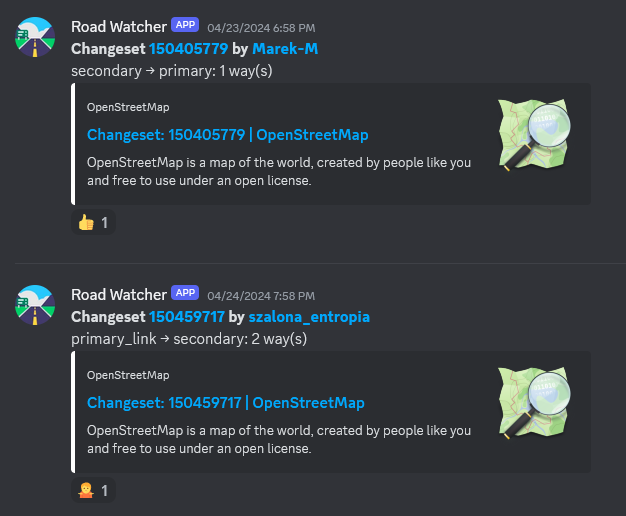
There are some object categories in OSM whose exact classification is often a matter of contention and edit wars. Main highways are one of the most prominent examples. There was a small edit war in Poland which resulted in no less than 4 blocks, but I did not let that crisis go to waste:
Behold road-watcher, a quick Python project that regurarly queries Overpass API for highway=secondary and above within a specified boundary and then detects any classification changes, sending them to a Discord channel (though it’s trivial to substitute it with another means of notification).
Posted by mvogelsteller on 26 April 2024 in German (Deutsch).
OpenStreetMap (OSM) hat sich als wertvolles Tool für viele Branchen erwiesen, darunter auch die Hotelbranche. Die Integration von OSM in die Online-Strategie eines Hotels kann dessen Sichtbarkeit und Suchmaschinenoptimierung (SEO) erheblich verbessern. In diesem Artikel erkunden wir, warum OpenStreetMap für Hotel-SEO wichtig ist und wie Hotels von dessen Einsatz profitieren können.
Erhöhte Online-Präsenz für Hotels
Einer der größten Vorteile der Nutzung von OpenStreetMap ist die verbesserte Online-Präsenz. Hotels, die auf OSM gelistet sind, erscheinen in einer Vielzahl von Map-Anwendungen und Diensten, die OSM-Daten nutzen. Das schließt beliebte Apps für Navigation und Reiseplanung ein, welche täglich von Millionen Nutzern verwendet werden. Diese erhöhte Sichtbarkeit kann dazu führen, dass ein Hotel von potenziellen Gästen leichter gefunden wird, was die Wahrscheinlichkeit von Buchungen erhöht.
Lokale SEO-Optimierung für Hotellerie
Lokale Suchmaschinenoptimierung ist für Hotels besonders wichtig. Wenn Ihr Hotel auf OSM gut repräsentiert ist, verbessert es die lokale SEO, da die Plattform von verschiedenen Kartendiensten und Suchmaschinen zur Datenverifizierung genutzt wird. Eine korrekte und detaillierte Darstellung in OSM hilft Suchmaschinen zu verstehen, wo sich Ihr Hotel genau befindet und welche Dienstleistungen es bietet. Dies ist entscheidend, wenn Nutzer nach Hotels in einer bestimmten Region oder Stadt suchen.
Kostenfreie und bearbeitbare Plattform
Im Gegensatz zu vielen anderen Kartendiensten ist OpenStreetMap kostenlos und von einer Community getrieben. Hotels können ihre eigenen Einträge hinzufügen oder bestehende aktualisieren, um sicherzustellen, dass die Informationen immer korrekt und auf dem neuesten Stand sind. Diese Aktualität und Genauigkeit der Daten ist für die SEO-Performance entscheidend. Durch regelmäßige Updates können Hotels ihre Sichtbarkeit in lokalen Suchergebnissen verbessern und sich positiv von der Konkurrenz abheben.