 OpenStreetMap

Marine Renewable Energy Laboratory
Users' Diaries
Recent diary entries
Posted by daniel-j-h on 9 May 2024 in English.

With 2024 officially being the year of OpenStreetMap vector maps let’s do a deep-dive into vector maps: their history and how the underlying vector tiles work in detail.

Vector Maps History
To understand how revolutionary vector maps were we have to go back in time to the early 2010s. One Direction is raising to international fame and raster maps are at the height of their popularity. Folks creating raster web maps rendering OpenStreetMap data into beautiful 256x256 pixel images.
But raster maps come with limitations: when you rotate the map the labels stop facing you; you can’t customize pre-rendered maps to specific use-cases on the fly; there is no fractional scaling between zoom levels. All of these problems are unthinkable nowadays: here is one example where Jochen wrote about Wikipedia struggling with pre-rendering multilingual maps for over 200 languages because they can’t change their map’s language on the fly.

Welcome to the sixth OpenStreetMap NextGen development diary.
This week, I continued the preparation of the project for the first development release scheduled for the end of this month 🔨.
🔖 You can read my other development diaries here:
osm.org/user/NorthCrab/diary/
📖 This project is open-source and publicly available:
https://github.com/Zaczero/openstreetmap-ng
🛈 This independent initiative is not affiliated with the OpenStreetMap Foundation.
In Case You Missed It…
OpenStreetMap-NG is planned to have its first development release at the end of this month, May. After this milestone, the project will be open for new contributors! My current work focuses on delivering on that promise, finishing the core functionalities, and stabilizing the code.
Originally posted in diary #5.5.
Finishing Up the Elements Sidebar
The elements sidebar has been mostly finished. The “Part of” and “Members/Nodes” sections are now more consistent in design and have received pagination support. The orange-colored map visualization is also now working.

I’m excited to announce that today we released Rapid v2.3 editor for OpenStreetMap! The Rapid team has been busy working on this for the past few months - here’s 4 new features that we hope you’ll love…
🔙 Esri Wayback imagery
The world never stops changing! We added a new background layer called “Esri Wayback” to let you view historical releases of the Esri World Imagery. This background source also has a date picker to help you choose from dates likely to show changes in the current map view. Open the Background pane to try it out!
🔄 Map Rotation
Take Rapid for a spin! Now you can rotate the map to make your editing easier (and avoid straining your neck!). Rapid supports rotating with option+click-drag or shift+←/→ arrows, just like other maps you’ve used before. A new bearing control displays a north arrow, and you can click it to reset the map back to North-up.
Posted by Jonachi on 8 May 2024 in Spanish (Español).

asdasd
Posted by wljrodrigues on 8 May 2024 in Brazilian Portuguese (Português do Brasil).

Testando coordenadas geográficas OpenStreetMap.
Posted by monhiko on 8 May 2024 in Chinese (China) (中文(中国大陆)).
Last updated on 10 June 2025.

大家好!这里是monhiko!(/ω\)
这是本人第一次尝试在OSM上写的一篇日志(因为今天才刚刚发现原来我也能写),所以就结合最近我国OSM地图上出现的一些情况对2023版《公开地图内容表示规范》(内容详见:公开地图内容表示规范,以下简称《规范》)进行一个解读,希望相关的mapper们能够在守法的情况下绘制OSM地图,让OSM地图更好的为我们的日常科研服务!
希望各位小伙伴们看完后记得一键三连(bushi)
一、主要解读内容
由于《规范内容》实在太多,涉及到OSM的也就几点,因此此次解读主要针对以下章节点:
第十八条
第十九条
第二十条
第二十一条
第二十二条
好的,下面咱不多说,我们直接走起!
二、具体解读
第十八条
该条规定:“…我国境内公开悬挂标牌的单位可在地图上表示单位名称。用于公共服务的设施,可在地图上表示其名称等可公开属性信息”
这条意思是说,在OSM上只要你看见有关公共服务设施(机关单位)是正式挂了牌的、能够在百度高德天地图上面搜到的,那么就可以在OSM上画出来。
那么“公共服务设施”包括哪些呢?根据《城市居住区规划设计规范》,公共设施主要包括以下几类,下面带你学习/复习一下:
1. 教育设施
主要包括托儿所、幼儿园、小学、中学等,在OSM上对应“幼儿园”(托儿所、幼儿园)及“学校”(小学、中学)两个tag。
大学算什么呢?答:大学基本上算是地市及以上等级的部门管的,小小社区无权独占。注意:军事院校一般为安全起见,除985211双一流类知名院校可作为“大学”而非“军事设施”标注外其余一律不标。
2. 医疗卫生
包括医院、诊所、卫生站等,在OSM上对应“医院”、“诊所”(诊所、卫生站)这两个tag(精神病院会在后面讲)。
3. 文化体育
包括影剧院、俱乐部、图书馆、老年人活动室、会所等,在OSM上对应“剧院”、“俱乐部”(俱乐部、会所)、“图书馆”、“社区活动中心”等。
4. 商业服务
包括食品店、菜场、服装、药房、理发店等,在OSM上对应“便利店”、“市场”、“服饰店”、“药房”、“理发店”等。
5. 金融邮电
包括银行、储蓄所、邮电局、邮政所、证券交易所、快递驿站等,在OSM上对应“银行”(银行、储蓄所)、“邮局”(邮电局、邮政所、快递驿站)等。
证券交易所咋标?建议去OSMWiki查,因为我旅游的路上没有去见过(bushi)
6. 社区服务
包括居民委员会、派出所、物业管理等。居民委员会因分街道居委会和社区居委会,因此对于居委会详见OSMWiki。
物业管理咋标?如果你能确定其位置的话,那就标为“物业管理”之类的。(派出所这块会在后面讲)
7. 市政公用
包括公共厕所、变电所、消防站、垃圾站、水泵房、煤气调压站等。其中,仅允许公共厕所(对应tag为“厕所”)、消防站(对应tag为“消防站”)和垃圾站(对应tag详见OSMWiki)能标。
其他的呢?会在下面讲。
8. 行政管理
包括商业管理、街道办事处等行政管理机构。对于这一类,窃以为谨慎处理,标点、面还是行的,内部的建筑、用地这些的话。。。自己心中要有一杆秤,你经过深思熟虑、参考国内多类型地图后确定认为标这些东西出来不会危及国家安全的话你就画吧。(注意这句话,下文中我会简称为“一杆秤原则”)
综上所述,这八类公共服务设施只要上面中允许标出且能够在国内地图上搜得到,就应标尽标,以充实地图内容。
第十九条
该条规定:“…表现地为我国境内的地图平面精度应当不优于10米(不含),高程精度应当不优于15米(不含),等高线的等高距应当不小于20米(不含)。依法公布的高程点可公开表示”
这条意思是说,你在画OSM时放大精度不得大于10米(对应放大等级20级),毕竟你只是画画,不是来玩测绘的(当然如果要严格按照《测绘法》以及各省市区对该法的实施方案的有关规定,实际上哪怕精度你放宽到20米你都要报请至少县级的自然资源及测绘主管机关单位申请基础测绘资格了)。当然,在这一精度范围之内,只要你能够看得清楚且不违反前后所述禁止及限制事项的(比如一棵树、一个垃圾桶)是可以的哦!
第二十条
该条规定:“…表现地为我国境内的地图不得表示下列内容(对社会公众开放的除外):
(一)军队指挥机关、指挥工程、作战工程,军用机场、港口、码头,营区、训练场、试验场,军用洞库、仓库,军用信息基础设施,军用侦察、导航、观测台站,军用测量、导航、助航标志,军用公路、铁路专用线,军用输电线路,军用输油、输水、输气管道,边防、海防管控设施等直接用于军事目的的各种军事设施;
chính sac
U
Posted by umbraosmbr on 7 May 2024 in English.


collaborative live mapping of regions affected by rain in Rio Grande do Sul - Brazil.
Today we are going to map the area that was affected by the rains in the state of Rio Grande do Sul, there will be a live broadcast at 7:00 pm where everyone can map and help with mapping the affected area.
task link. MAPPING OF ROADS IN THE AREA AFFECTED BY THE FLOOD OF THE PARDO RIVER IN CANDELÁRIA-RS https://tasks.hotosm.org/projects/16696
Youtube: https://www.youtube.com/watch?v=3Wm-nTnCRaQ&t=7s
organization: UFV youthmappers UMBRAOSM
live collaborative mapping in the affected areas of RS
Posted by Sawan Shariar on 7 May 2024 in English.

Greetings!
We are thrilled to share some exciting news from OpenStreetMap Bangladesh (OSMBD). For the first time ever, the OSM Bangladesh community has successfully formed an elected Executive Committee, consisting of a team of dedicated individuals who will guide our community’s activities and initiatives.
We are proud to introduce the newly elected Executive Committee:
President: S M Sawan Shariar
Vice-President: Atikur Rahman
Secretary: Samsul Arafin
Treasurer: Nahid Ferdous
Member-at-large: Mehedi Hasan Ovi
Member-at-large: Afia Tahmin Jahin
Member-at-large: Laila Sharmin Nova
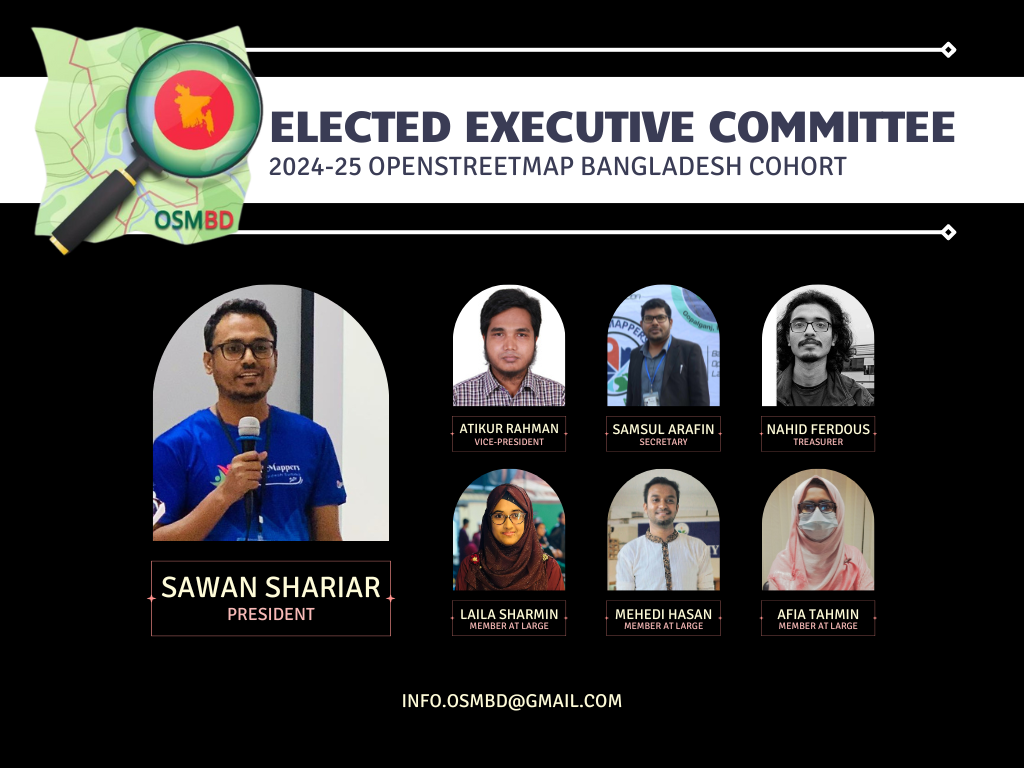
The committee is committed to upholding OSMBD’s core values of collaboration, community-driven initiatives, openness, and accessibility. Our focus is on promoting the use and development of OpenStreetMap in Bangladesh, building and maintaining a comprehensive map of Bangladesh that is freely accessible, and supporting OSM groups and initiatives through training, events, and more.

Hello OSM World,
Welcome to #WOSMinGhana 000
I am starting a series of OSM Diary posts title Worst of OSM in Ghana, inspired by best and worst of OSM posts I have seen. The idea is to share one photo per week (I hope I can keep up, feel free to share any you might have seen in Ghana too :D). i.e. Before and After (if I am able to improve or fix it)
Sometimes you come across very interesting mapping activities and data and you are out of words. Myself and other volunteer mappers have taken screenshots of worst contributions on OSM in Ghana over the years and then proceeded to improve them / notify mappers or organizations.
Why talk about the worst not the best? Highlighting these worst mappings might help create more awareness about what we put out there as part of individual or organized mapping activities.
This is purposely to help improve OSM data in Ghana in these areas by myself or other mappers and for us all to beware of when mapping.
Looking forward to the coming weeks.
Posted by TrickyFoxy on 6 May 2024 in Russian (Русский).
Last updated on 12 May 2024.

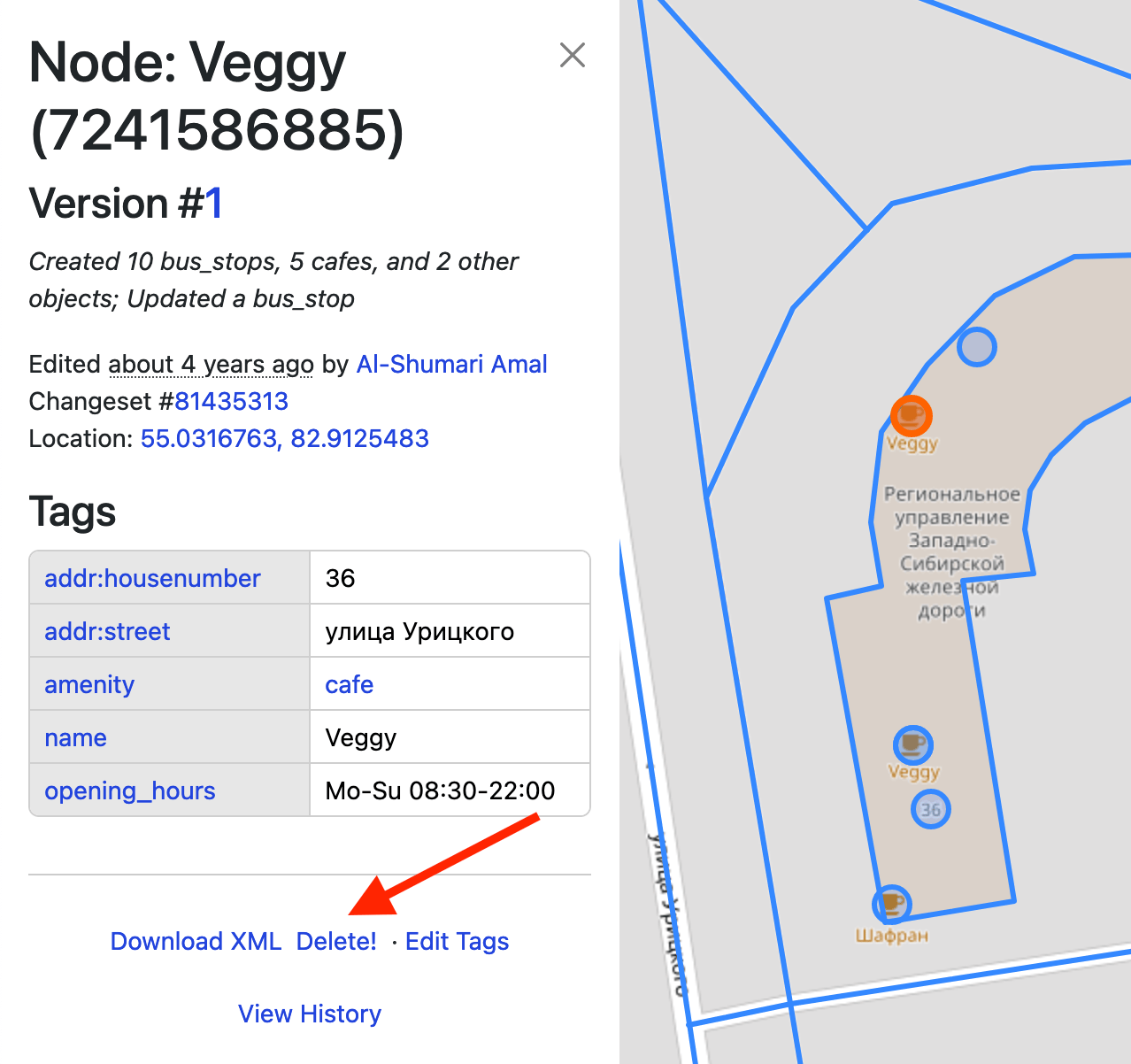
Написал юзерскрипт для Tampermonkey, добавляющий несколько полезных мелочей:
- Удалятель точек
- Улучшенная работа с заметками
- Компактная история объектов
- HDYC в профиле пользователей
- Компактная информации о правке
- Кнопка отката
🔫 Удалятель точек
📝 Улучшенная работа с заметками
- При открытии заметок теперь вы можете включить спутниковые снимки
- Появилась кнопка с быстрым комментарием к заметке
- Появилась кнопка, которая с помощью Overpass показывает состояние карты на момент создания заметки
- Убирается мещающая оранжевая обводка около активной заметки
Posted by Charlie 07 on 6 May 2024 in English.
Introduction
Humanitarian logistics is defined as the process of planning, implementing and controlling the efficient, cost-effective flow and storage of goods and materials, as well as related information, from the point of origin to the end of consumption to alleviate the suffering of vulnerable people
Its Extent and Impacts
The humanitarian logistics of peace operations in sub-Saharan Africa is one of the most challenging operations in the contemporary world. Faced with this reality, several scenarios challenge conventional logistical practices translated into humanitarian efforts on the African continent. Several events have led Africa to the current situation, whose conflicts have worsened the case in some countries. In this scenario, three countries stand out on the African continent: South Sudan (SS), the Central African Republic (CAR) and the Democratic Republic of Congo (DRC).
1.Positive Impacts
Data Collection and Mapping - GIS technology is used to collect, analyze, and visualize geospatial data. Humanitarian organizations in South Sudan leverage GIS to map various elements such as population distributions, events, infrastructure, health facilities, water sources, and more. This comprehensive mapping enables organizations to identify vulnerable areas and better understand the needs of the population.
Situation and Needs Assessment - OSM aids in conducting rapid situation assessments and needs analyses during crises and emergencies. Each region in South Sudan is prominently represented by one or the other ethnic and communal group, each with its own methods of action. By overlaying various data layers, including demographic, environmental, and public infrastructure, organizations can quickly identify areas that require immediate specialized attention and allocate resources accordingly.

Ça faisait un moment que je n’avais plus fait un update, mais mieux vaut tard que jamais.
Pour faire simple, il y a pas mal de choses que j’ai ajouté/corrigé sur OSM depuis la dernière fois (le boulevard urbain de Seraing et ses pistes cyclo-piétonnes, revêtement d’un paquet de rues/chemins/sentiers sur Seraing également, des installations éoliennes sur Engis, divers sentiers/chemins sur Neupré + utilisation des sols, etc) et parfois j’ai enregistré la session qui va avec, mais je me rends compte que ce n’est pas très intéressant ou je suis trop brouillon dans mes explications ou c’est un update trop ambitieux (comprendre la vidéo finale sera trop longue), ce qui me pousse à ne pas utiliser l’enregistrement ou le couper au milieu pour me concentrer sur ce que je fais sur OSM à la place (c’est le plus important après tout 😉).
Un autre changement important est que j’utilise un nouvel éditeur vidéo depuis le dernier update. Jusqu’ici, j’utilisais Openshot qui est assez simple d’utilisation mais devenait un peu basique à mon goût, et maintenant je suis sur Kdenlive qui me permet d’éditer mes vidéos de manière plus précise et de couper les temps-morts le plus possible (sans doute au prix de la fluidité parfois 😅).
Évidemment, il y a plus que trois vidéos cette fois-ci, mais c’est aussi sur une période de trois mois. J’ai aussi fait sur OpenHistoricalMap, mais je ne vais plus les mentionner ici vu que c’est OSM et pas OHM.
Améliorons Flémalle (sur OpenStreetMap) - Épisode 7 (Ivoz-Ramet et ses “problèmes”) - Version Live de cet update où je corrige divers “problèmes” sur Ivoz-Ramet
Améliorons Seraing (sur OpenStreetMap) - Épisode 32 (La quête des bornes continue!) - Version live de cet update qui est le résultat de ma première sortie VTT depuis mon opération… et mon pneu avant crevé 😡
아래 풍력발전기들은 위성사진상 풍력발전기인 건 맞으나, 어느 발전소인지 불명확한 것들임. 아마도 발전기 설치만 하고 계통병입을 아직 안 해서 EPSIS에 집계가 안 되고 있는 상황인 것으로 여겨짐. 추후 EPSIS에 노출되는 대로 정리 및 추가할 예정.
노드번호 Ref 위도 경도 구좌읍 월정리 node/6740186186 n.a. 33.5168579 126.7594851
구좌읍 김녕리 node/7641971542 n.a. 33.5587855 126.7711681 node/7641971500 n.a. 33.5633738 126.7724564
홍성군 node/9196588574 n.a. 36.5196404 126.4383888
부안군 node/11336347287 n.a. 35.5804069 126.665816 node/11336347288 n.a. 35.5804614 126.6656966 node/11336347289 n.a. 35.5805934 126.6656148 node/11336347290 n.a. 35.5807025 126.665584 node/11336347291 n.a. 35.5808432 126.66558
울릉군 node/10805235767 n.a. 37.5156583 130.815123
구좌읍 행원리 node/10763132616 n.a. 33.5540301 126.821713 node/6740186185 n.a. 33.5164777 126.7595529 node/3753982805 n.a. 33.5378955 126.7886977
태안군 node/10236801603 소형 발전 36.7694299 126.304618
해남군 화산면 삼마리 node/6979989839 n.a. 34.4369591 126.4321187 node/6979989840 n.a. 34.436909 126.4320674 node/6979989841 n.a. 34.4368105 126.4320219 node/6979989842 n.a. 34.4367229 126.432204 node/6979989843 n.a. 34.4367886 126.4322799 node/6979989844 n.a. 34.4368496 126.4323444 node/6979989845 n.a. 34.4366369 126.4323595 node/6979989846 n.a. 34.4366979 126.4324335 node/6979989847 n.a. 34.4367573 126.4324999 node/6979989848 n.a. 34.4366181 126.4325568 node/6979989849 n.a. 34.4372172 126.4326744 node/6979989850 n.a. 34.4374252 126.4327275 node/6979989851 n.a. 34.4365847 126.4330987 node/6979989852 n.a. 34.4370462 126.4325335
거창군 북상면 node/4483840546 n.a. 35.7911736 127.704751

不渲染landuse=religious的名称与宗教种类图标
根据wiki,landuse=religious用于标注整座庙宇的占地,而amenity=place_of_worship用于标注实际进行礼拜所用的建筑、广场等。然而,Carto图层只会对后者渲染名称和宗教种类图标。在西方,教堂、清真寺等往往是一栋大建筑,于是只要给他加上amenity=place_of_worship,就能顺利把名称和一个图标显示在地图上了。然而,东亚的宗教场所大多是多栋殿宇、房屋组成的院落,各有其名,其中并没有一个直接冠以该宗教场所名称的主体建筑。 这就导致,按照wiki要求标注的话,Carto图层上根本看不到寺院的名称,而如果画了建筑的话,会看到密密麻麻的宗教图标(每栋殿堂一个),没画的话则连宗教图标都没有。
不渲染单独的attraction=
该标签用于标注游乐设施,其中attraction=animal用于标注动物园的展区。根据wiki,attraction=不是tourism=attraction的子项,不用加tourism=attraction,iD的预设也是单独的标签。 但在Carto图层中,单独的attraction=是不渲染的。这导致很多编辑者标注游乐设施时同时加了tourism=attraction。
不渲染标为区域的place=farm和amenity=research_institute
我是在画农场时遇到的。据wiki,二者分别用来标记用于生产的和用于研究或学术目的的农场。有的农场有明确的围墙包围了田地和院落,只把名字写在landuse=farmyard区域不甚妥当。但把名称写在这两个标签上的话,在Carto图层是看不到这里有农场的。 此外,自然还有别的许多研究所也都不渲染出来。

Keep removing my edits.. go ahead. I can just waste my time and add them back. I have no problem doing that.

Kena survey balik semua kawasan kalau ada masa. Terlupa nak backup punca lupa 😭