OpenStreetMap logo OpenStreetMap

Users' Diaries

Recent diary entries

Posted by TBesse on 3 August 2024 in German (Deutsch). Last updated on 7 August 2024.

Im 18. Jahrhundert wurden um Falscheid zu den Nachbarn Reisweiler, Labach und Knorscheid mehr als 40 Hoheits- und Banngrenzsteine gesetzt. Davon waren bisher nur wenige Steine beispielsweise im Golocher Wald in OSM erfasst. Aufgrund eigener Forschungen aus den Jahren 2021/22 konnte ich heute einen Großteil dieser stattlichen, mit zahlreichen Markern versehenen historischen Banngrenzsteine um Falscheid in OSM kartieren (http://overpass-turbo.eu/s/1PoF). Falscheid gehörte bis 1767 teilweise zu der lothringischen Herrschaft Creange und teilweise zur Grafschaft Nassau-Saarbrücken und wurde aber im Jahr 1767 von Nassau-Saarbrücken mit Frankreich eingetauscht. Die im Jahr 1790 zu Knorscheid hin ausgesteinte Banngrenze war somit nur noch eine Grenze zwischen zwei in der Grafschaft Nassau-Saarbrücken liegenden Orten. Viele dieser historischen Grenzsteine sind noch sehr gut erhalten, weil sie in den angrenzenden Wäldern stehen. Mehr unter http://www.besse.de/buecher/2024_Falscheider_Grenzstein-Tour.pdf

Hier die Wanderkarte um Falscheid mit den fehlenden (rot) und vorhandenen (blau) historischen Grenzsteinen aus dem 18. Jh.
See full entry

Location: Überhofen, Riegelsberg, Regionalverband Saarbrücken, Saarland, Deutschland

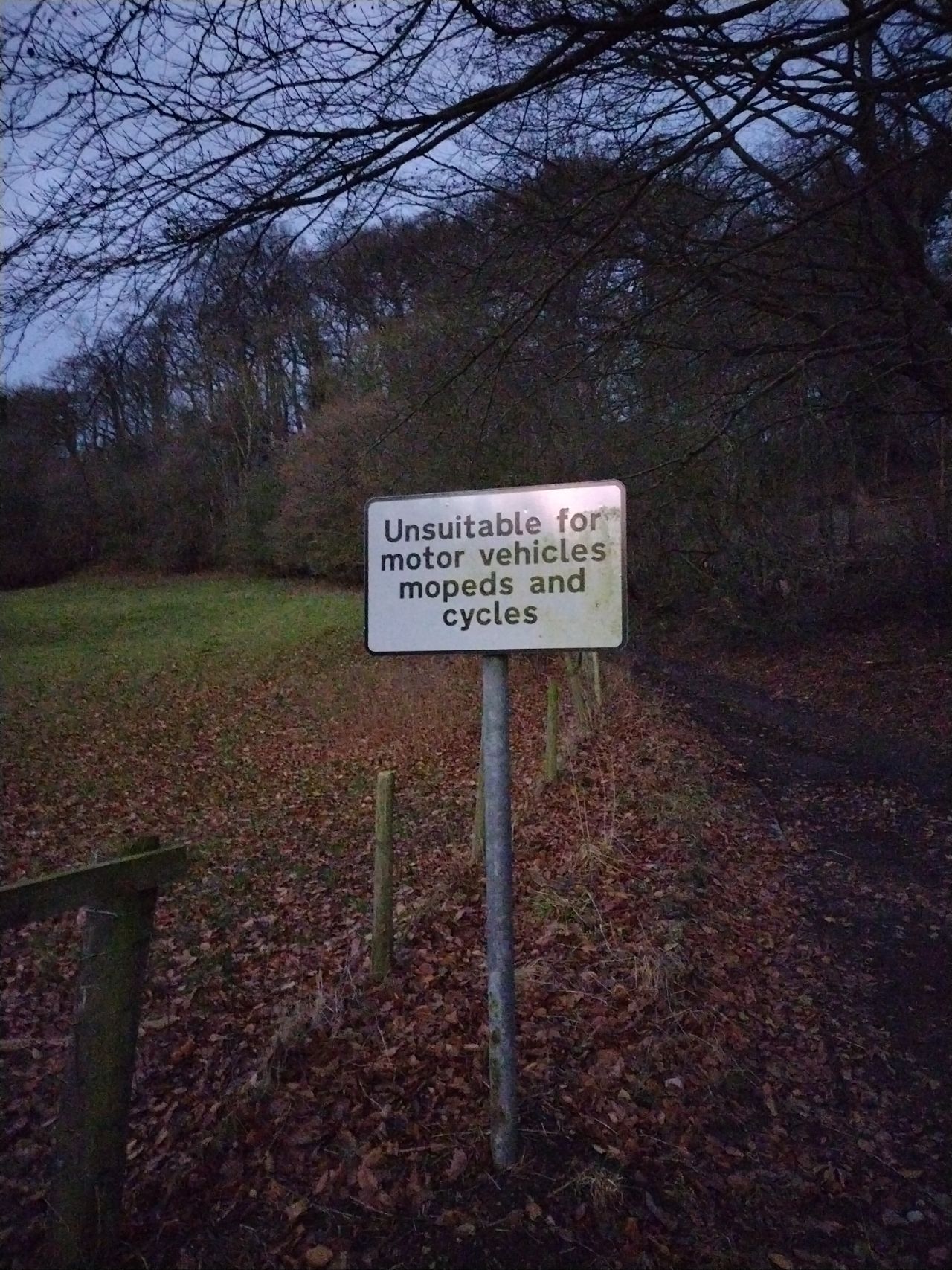
Unsuitable for motor vehicles mopeds and cyclists

My previous diary entry looked at the UK section of this OSM wiki page. A commenter there noticed that neither the wiki table nor my analysis covered highway=track (covered here) or highway=service (left for later).

We’ll use the same approach as before. Essentially, that’s this urban area (and this when looking at designation), and this rural area.

It’s useful to look at designation because that tells us what some of the access values should be, and also local authority data about public rights of way such such as visible in this overlay. We’ll therefore ignore ways in OSM with designation set but look to see if any of our examples “should” be designated as a public right of way.

See full entry

Location: Oldstead Mill, Oldstead, North Yorkshire, York and North Yorkshire, England, YO61 4BL, United Kingdom
Posted by NorthCrab on 2 August 2024 in English. Last updated on 16 August 2024.

Welcome to the sixteenth OpenStreetMap NextGen development diary.

This week, we continue focusing on feature parity and migration efforts.

🔖 You can read other development diaries here:
osm.org/user/NorthCrab/diary/

⭐ This project is open-source — join us today:
https://github.com/openstreetmap-ng/openstreetmap-ng

🛈 This initiative is not affiliated with the OpenStreetMap Foundation.

Project Keeps Growing

Before we get started with this week’s highlights, I want to highlight the continuous growth of the project in terms of popularity on GitHub. It’s amazing to see the community in action - thank you all! It keeps us all motivated! 🌠

Star History Chart

Geolocation Icon Pt.2

Last week, we talked about the new geolocation icon design. This week, we have iterated on it and created a custom design that looks and feels just right. Check it out:

See full entry

This is a diary about a recent drone mapping initiative that I participated in. I would like to give credits to the Open Mapping Hub - West and North Africa, OpenStreetMap Sierra Leone, Pete Masters and Ivan Gayton for all the support and knowledge given during the course of this initiative. I hope to learn more as we continue collaborating.

Purpose

The use of satellite imagery from multiple sources has been a pivotal aspect of open mapping campaigns across the world. However, satellite imageries have some limitations, such as low resolutions and delayed visitation time. This affects the quality of the digitization of physical features that are to be mapped. In order to address these limitations in open mapping campaigns, the use of Unmanned Aircraft Systems such as drones have been employed to capture images with high resolutions within desired timeframe.

Scope

With support from the West and North Africa Hub through the Mwalai microgrant, OpenStreetMap Sierra Leone embarked on the collection and processing of drone imageries in three slums across Freetown as part of the Know Your City initiative. The imageries would be used to map buildings and critical infrastructure, test the fAIr model and Field Mapping Tasking Manager.

Technical Specifications/Parameters

In order to have high resolution imagery, the team used a DJI Mavic 2 Zoom drone for the flights and Open Drone Map for the image processing. A smartphone-based flight planning and control application was used to conduct flights with specific elevation, overlap, and angle settings, allowing the operators to ensure consistent resolution, quality, and coverage across the areas of interest.

Flights were conducted above slums with dense buildings, therefore, flight settings with paths and gimbal angles that captured the top and sides of buildings and other infrastructure. The team used the following flight settings. 70% Frontal Overlap 80% Side Overlap -75 degrees Gimbal Angle

Processing

See full entry

Location: Mirimboe, Freetown, Western Area Urban, Western Area, Sierra Leone
Posted by Ella92282 on 2 August 2024 in English.

Today I woke, cold and alone me. This day unlike any almost except I’m still alone, but today was different. Tonight I mean as 4 :55 ish in the morn , it was as if I had given birth to yesterdays sorrows and as if I’m lying in bed waiting for them to begin walking from a crawl as a toddler does when it first uses it’s feet to wind it’s legs up and run away. Today is now a new day as yesterdays sorrows have become real with their own love deform so it can take its sadness that makes it sorrow and simply , with its own life form simply walk away. Now the dark, like belt, place inside called sorrow simply became and ran away, so now only I have to face today and the sorrow is now lol Niger feeding of my light or life and today is Jacqueline still that it’s mine “just for today”.

INTRODUCTION

The fieldwork of Anticipatory action mapping was conducted on Wednesday, July 24th, 2024 in the Western province of Rwanda, Ngororero district by the ecoMappers of OpenStreetMap Rwanda with the collaborative partnership of the administration of Ngororero district, and the volunteers who reside in this district. The fieldwork mainly aimed to acquire information from the leaders and community about the hotspots that had rainfall-induced landslides, and flooding, onboarding new volunteer members, and verifying the digitization status.

Description of activities

This fieldwork was a great opportunity that resulted in the onboarding of new volunteer members by matching the experienced mapper with the new one so that they could exchange skills and be aware of different tools that they can use while mapping, they learned the other different map features and how to use tags identifying those features.

Spatial analysis Field work objectives

From the ability to show the hotspot in google Earth to extracting the elevation , slope analysis and downloading the OSM data digitized around a particular hotspot.

During the field visit, the digitization status was verified using the mobile application Vespucci. On the field, the volunteers were briefed on how to download, install, and use the application. This enabled them to confirm the status of the digitization within the buffer of the hotspot.

See full entry

Location: Ngororero, Ngororero District, Western Province, Rwanda

After reading this forum topic and commenting that the United Kingdom part wasn’t great because it didn’t consider the different rules in England and Wales, Scotland, and Northern Ireland, I wondered “what should the defaults actually be for England and Wales?”.

Of that table, I think that the rows down to living_street are correct, and of the remaining rows the columns across to moped are also correct. I decided to pick a couple of areas I’m familiar with (one urban, one rural) and look for examples in those areas without explicit access tagging. Based on that it should be possible to suggest some sensible defaults.

path

The default of no for everything through to moped is correct, which leaves horse, bicycle and foot.

path, horse, urban

https://overpass-turbo.eu/s/1P4E

https://overpass-turbo.eu/s/1P4G

Mostly these ways are foot=permissive, and there’s no horse signage. In some of the parks horses might be tolerated; elsewhere likely not. This suggests horse=no here.

path, horse, rural

https://overpass-turbo.eu/s/1P4I

https://overpass-turbo.eu/s/1P4H

Mostly these ways are foot=permissive or =yes, and there’s no horse signage. In some of the parks horse access might be =permissive; in most cases not. This suggests horse=no for these as well.

path, bicycle, urban

https://overpass-turbo.eu/s/1P4J

https://overpass-turbo.eu/s/1P4K

Mostly these ways are foot=permissive. In a large number bicycle access is explicitly disallowed.

path, bicycle, rural

https://overpass-turbo.eu/s/1P4L

https://overpass-turbo.eu/s/1P4M

Mostly these ways are foot=permissive or =yes, and on some (but not as many as the urban ones) bicycle access is explicitly disallowed. However there are also some designated “public bridleways” which should be tagged bicycle=yes but are not, perhaps because bicycle access is legal but implausible

path, foot, urban

https://overpass-turbo.eu/s/1P4O

https://overpass-turbo.eu/s/1P4N

See full entry

Location: Kingstone, East Staffordshire, Staffordshire, England, United Kingdom

Von der 13 Kilometer langen Hoheitsgrenze um Eppelborn aus dem Jahr 1767 wurden bisher nur wenige Grenzsteine in OSM kartiert. Daher konnte ich nun den Großteil der 49 (von ehemals 90) heute noch erhaltenen Steine neu erfassen (http://overpass-turbo.eu/s/1PoJ). Bei dieser Gelegenheit habe ich auch meine aus dem Jahr 2021 stammende Eppelborner Grenzstein-Tour überarbeitet und auf meine Website neu aufgespielt (siehe unter http://www.besse.de/buecher/2024_Eppelborner_Grenzstein-Tour.pdf). Darin sind alle vier Seiten der Grenzsteine abgebildet. Zudem wurden die Marker mit weißer Kreide nachgezogen, so dass man auf den Fotos eindeutig lesen kann, was hier früher eingemeißelt worden ist. Diese Vorgehensweise empfehle ich jedem Fotographen, der die noch fehlenden images zu den Steinen zu den Eppelborner Grenzzügen noch ergänzen möchte. Aktuelle images sollten jeden Grenzstein zieren.

Nachstehend wird ein Ausschnitt zwischen Dirmingen und Thalexweiler aus der 1767 Original-Aussteinungskarte aus dem BayHStArchiv veröffentlicht:

See full entry

I am struggling to write a diary entry every day, but I am making up for it by mapping more in the surrounding areas of every village I map. During the past 5 days i have mapped the villages:

1 - Bubq

2 - Mengël

3 - Gjokaj

4 - Nangë

5 - Bicaj

6 - Ngraçan

7 - Bishqethem

A big thank you to ibanez for mapping Bllatë e Poshtme.

“#100villagesin100days”

Posted by leonkhay95 on 30 July 2024 in English.

Hello OSM community,

I’m excited to share my experiences as a participant and trainer in the OM Guru Fellowship, 2024. My name is Kyaw Zayar Linn, and I’m from Myanmar. I work as a GIS officer at CDE Myanmar. I’ve mostly used GIS software like ArcGIS and QGIS but have limited experience with OSM. So, this program has been an incredible journey of learning, growth, and community engagement.

My Journey Before joining this fellowship program, my experience with OSM was primarily limited to downloading OSM data and using it in GIS software. While I knew that I could edit and contribute to OSM, I lacked the practical knowledge on how to effectively edit and contribute data. Also, thanks to the Person who encourage to do OSM contribution and explain opportunity of OpenStreetMap for Myanmar that Myanmar is lacking free vector map.

From the moment I joined the OM Guru Fellowship, I knew I was embarking on a unique adventure. The fellowship provided a structured platform for me to enhance my mapping, validating skills, collaborate with fellows and contribute to meaningful projects on HOT Tasking Manager. One of the highlights was working on HOT Tasking Manager Projects, where I learned the HOT Tasking Manager plays a crucial role in leveraging the collective efforts of a global community of volunteers to improve mapping data where it is most needed. It supports humanitarian organizations and local communities in making informed decisions based on accurate and up-to-date geographic information.

See full entry

Location: Chiang Mai City Municipality, Fa Ham, Mueang Chiang Mai District, Chiang Mai Province, Thailand

The problem

We are generating an increasing level of data as a society. An unstated goal of openstreetmap that many contributors subscribe to is “completeness” or “accuracy”, which works fine when you dataset is small, local and high level detail, but less so when scaled up to determining if every traffic light crossing in the world has tactile paving.

So naturally, automation and data imports are where people start to look; and very sensibly there’s a process to propose, review and ingest large datasets.

However, this relies on:

  • Expertise and peer review
  • Honesty and diligence of the importer to have and execute a QA plan
  • A second level of QA tools and mappers to QA and maintain data

What could we do differently?

In the semantic web/linked data world, two big concepts emerged. The first is the semantic web layer cake, which talks about going from “machine readable” to “schemas” to “query” to “proof” to “trust”. In OSM terms these are poi, tags, overpass, a lot of tools like keep right or osmose, and at the moment, human boots on the ground survey.

The concept of 5 star open data is focused on the idea that we have a lot of data locked up in silos - and while it would be ideal to align it to every standard and have the highest quality possible data; 95% of the time it’s better to publish anything at all rather than wait until it’s perfect. So long as data consumers have an idea of the limitations, they can apply judgement when attempting to use it.

What is the current state?

A number of open data portals provide basic indicators of “5 star open data” quality.

In our wiki, we maintain documentation which describes the OSM community’s view on data quality of an external dataset.

We have tags for change sets describing the source.

What specifically would we change?

See full entry

En Colombia hemos buscado cómo participar de los cumpleaños de OSM, ya sea haciendo un evento de mapeo virtual o una GeoBeer Virtual, como ocurrió el año pasado. Pero este año queríamos hacer algo diferente, queríamos escuchar las voces de los mapeadores, que nos contaran sus historias, queríamos aprender de cada uno de ellos y que pudiéramos compartir estos con todo el mundo. Por eso decidimos hacer unas entrevistas virtuales que compartiremos en redes sociales y listaremos en este post.

Para la realización de esto nos apoyaron:

  • Sebastián Bravo.
  • Santiago Gonzáles.
  • Angie Trujillo
  • Rafael Isturiz.
  • Andrés Gómez.

Usamos la plataforma vdo.ninja para poder ver y escuchar a los invitados, y pudiéramos ajustar la disposición del video. Lo pasábamos a OBS donde lo grabámos. Finalmente, lo procesamos en inShot para ponerle unos efectos adicionales.

Una vez los videos hechos, los publicamos en las redes sociales de OSM Colombia, OSM LatAm o MaptimeBogota:

Colombia

See full entry

Im Jahr 1791 wurde die Grenze zwischen den zur Vierherrschaft Lebach gehörenden Orten und den seit 1787 zu dem Herzogtum Pfalz-Zweibrücken neu hinzugekommenen Orten Bettingen, Gresaubach, Steinbach, Thalexweiler und Aschbach mit 61 Grenzsteinen neu ausgesteint. Davon sind heute noch 24 stattliche Hoheitsgrenzsteine mit Pfalz-Zweibrücker Rautewappen erhalten geblieben. Diese konnten nun in OSM kartiert werden (http://overpass-turbo.eu/s/1PoK). Mehr hier https://www.besse.de/buecher/2024_Lebacher_Grenzstein-Tour.pdf

Hier die Grenzsteinkarte: Wanderkarte

Even though I have not been able to write a diary entry every day, I have managed to map a village or more every day.

Now I am at the airport of Athens, waiting for the airplane to travel back home, and found the time to write this diary entry. In the past days I have mapped the villages Pac, Gjergjan, Kaçinar, Romës, Selckë, Bukmirë and many smaller villages surrounding the above-mentioned villages.

I would also like to publicly thank again perenniallylate for mapping other two villages in Albania, Rusinjë and Kuqar.

“#100villagesin100days “

良かった点

・複数の航空写真から吟味してマッピングした

・航空写真だけでもかなりの密度のマッピングが可能だと判明

 → この結果、国内でも中々お目に掛かれない密度へ(しかも農村部で、おそらく私がマッピングしなければ100年は放置されていたであろう)

反省点

・比較的新しい航空写真を見つけることが思いの外難しかった

・やっぱり現地調査を行なってくれるユーザーが居ないと辛いところがある (コンビニっぽい建物にセブンイレブンのポイントを追加してくれるだけで謎の多幸感に襲われた)

・恐らく必要以上に水路をマッピングした地域がある (先日、青い森鉄道や東北新幹線から田んぼを凝視したが、明らかに田んぼである所を水路にしてそうだなと思った)

・was:buildingタグの建物の削除を行なってしまった (これは私の無知。しかし、首都圏などでこれを一々マッピングしてたらとんでもないことになりそうだと推測)

疑問点

・牧草地と耕作地の違い

→現地調査してくれるユーザーが登場するのを待つしかない(訓練された道民なら分かるのだろうが)

・耕作地はどの程度詳細に描くべきだろうか

→正直、クソデカ耕作地はもちろん、ブロック単位の耕作地もあまり好きではない。しかし、離農が相次ぐ現在では一反一反描画するのは現状をマッピングできているとは言えないとも考えられる。

しかし、災害時に使われることや将来的なことを考慮すると、現状のマッピング方法が好ましいと考えている。

・コンビニやガソリンスタンド、集合住宅っぽいものが航空写真に写っていたら、地図メモで残しておくのは有用か

→今後、現在マッピングしている上尾市で検証したい。

月形町でのノウハウは現在精力的にマッピングしている上尾市などで生かせればなあと思っている。

自分1人だったら正直、モチベーションが怪しかったので協力下さった皆さんには感謝しております。ありがとうございました。

Tasking Manager, an open-source project, recently undertook a significant migration: transitioning from Flask to FastAPI for our web framework and from psycopg to asyncpg for our database interactions. FastAPI offers substantial performance improvements by leveraging asynchronous programming and simplifying API development with automatic interactive documentation and modern Python features. asyncpg enhances database interaction throughput with its asynchronous design and high optimization. Despite challenges like the learning curve and extensive code refactoring, this transition promises enhanced performance and scalability, providing valuable insights for the community and encouraging the exploration of FastAPI and asyncpg for similar projects.

For a detailed account of our migration journey, read our full post here. We invite the community to get involved, share feedback, and contribute to Tasking Manager. Your insights and collaboration are invaluable as we continue to innovate and improve in the world of open-source software.