 OpenStreetMap

| [[Category:Users in Madagascar | hhrazaka]] |
Users' Diaries
Recent diary entries

My Talk at State of the Map 2024
(How the iD Editor still can to do better in the long term)
This September, I presented some ideas for the future of OSM’s iD editor at the State of the Map conference in Nairobi. Now, the video recording of the talk is online. To summarize the talk’s content: I identified two core challenges faced by the iD editor which need to be addressed in the upcoming years:
1. Data Complexity
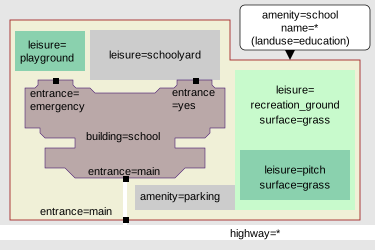
Naturally, OSM’s data got more complex over time – as an example, a simple school might have typically been mapped as a single POI node in OSM a couple of years ago, while nowadays the state of the art is to model it using multiple map features that are nested within each other. While this allows to represent the reality in a high level of detail, the added complexity needs to be accommodated for by the tooling, especially in an editor tailored for beginner mappers like iD. For a deep dive into this topic, see also Sarah Hoffmann’s talk at the same conference.

Перевел статью из вики ОСМ на русский.
Первая переведенная мною статья , надеюсь идея HD разметки дорог будет развиваться дальше.
Posted by Barro on 26 November 2024 in Finnish (Suomi).

Nyt sää alkaa olla sen verran kylmä, ja välillä luminen, että voidaan todeta, että on aika siirtää pyöräpysäköintipaikkojen kartoitus talvilevolle ja jatkaa urakkaa isommassa määrin sitten, kun pakkaset ovat taas väistyneet.
Kauden 2024 projektina itselläni oli seuraavanlaisia asioita läpikäytävänä omalta tarkastelualueeltani:
- Käydään määräpuutteelliset pyöräpysäköintialueet läpi ja täydennetään niihin olennaisimmat tiedot.
- Tarkistetaan pyöräpysäköintialueet, joihin ei ole koskettu sitten vuoden 2018 alun jälkeen, että onko mikään merkittävästi muuttunut.
- Käydään juna-asemien pyöräpysäköintimahdollisuudet läpi.
- Aloitetaan koulujen ja päiväkotien pyöräpysäköintimahdollisuuksien läpikäynti. Tästä tuli kirjoitettua Päiväkotien ja koulujen pyöräpysäköintitilanne -artikkelissa vähän pidemmälti.
Näissä projekteissa huomiona se, että kun merkitsen pyöräpysäköintimahdollisuuksia kartalle, en ota huomioon kiekonväännintelineiden olemassaoloa. Paitsi jos kyseinen pysäköintialue on jonkun muun lisäämä kartalle. Tähän syynä se, että kyseiset telineet on huonompi vaihtoehto pyörän pysäköinnin suhteen kuin kiinnittää pyörä aitaan tai tolppaan. Ja eivät toimi suunnitellusti isolle osalle pyörätyypeistä, jotka ei osu siihen yhteen platoniseen ideaaliipyörätyyppiin, jolle kyseinen telinemalli on mitoitettu.
Huomiota kiinnittäneitä asioita
Kartoituskauden aikana jotkut asiat kiinnitti huomiota positiivisessa määrin.
Posted by Graeme Herbert on 26 November 2024 in English.
Last updated on 18 December 2024.
Tabatinga To Manaus 3
By day 3 on the Manaus boat I was beginning to doubt that we might get there the next day. It seemed the boat was moving too slowly, we were tracking the route and there was a lot of river still before Manaus.

What we didn’t know is that the boat stops less on the second half of the journey, I guess because many of the places further downstream have their own services to Manaus. It did stop briefly in the river a couple of times just to let people off onto a smaller boat that was waiting.
The main event of the third day was a fairly thorough police check of the boat. I was fast asleep in my hammock when It happened, men had to line up on one side of the deck, women on the other. All baggage was also lined up in the middle so they could pass the sniffer dog by everything. We were stopped about an hour for this, it’s quite a routine thing on public transport here, I was told.
Posted by Raquel Dezidério Souto on 25 November 2024 in Brazilian Portuguese (Português do Brasil).
Last updated on 2 December 2024.

IVIDES.org promoveu oficina de mapeamento colaborativo com OpenStreetMap e criação de mapa Web com uMap
A oficina foi ministrada pela Dra. Raquel Dezidério Souto, presidenta do IVIDES.org, instituto virtual de pesquisa que, há 18 anos, tem se dedicado a disseminar conhecimento livre e trocar informações sobre temáticas relacionadas ao desenvolvimento sustentável (na visão de I. Sachs). A oficina faz parte da programação da VII Jornada de Geotecnologias do Estado do Rio de Janeiro - VII JGEOTEC e contou com recursos do IVIDES DATA e parceria com o Laboratório GeoCart-UFRJ.
Esta atividade corresponde à última, das 17 oficinas celebradas pelo IVIDES.org, somente em 2024, em cooperação com muitos atores importantes no Brasil, em países da América do Norte (como o México, neste ano) e países da África lusófona (como Moçambique, neste ano), de universidades federais, grupos YouthMappers (orientação para a criação de novos grupos e treinamento de grupos já existentes).
No vídeo, em português, são apresentados:
-
Conceitos iniciais sobre mapeamento colaborativo, de modo geral;
-
OpenStreetMap - modelo de dados, editores, APPs, plugins para QGIS;
-
uMap - detalhamento da configuração geral do mapa e configurações específicas para camadas; dicas de design para favorecer o carregamento do mapa; treinamento com dados do Censo Demográfico do Brasil de 2022, demonstração sobre importação de dados para gerar camada estática; e criação de camada dinâmica, a partir de consulta com Overpass Turbo.
Vídeo gravado da Live
https://www.youtube.com/live/5w21smhYN1k
Para entrar em contato, favor enviar mensagem para: ivides@ivides.org
IVIDES.org® é uma marca registrada.
IVIDES DATA é uma empresa de pequeno porte, sediada no Rio de Janeiro, de consultoria em tecnologia da informação.
GeoCart - Laboratório de Cartografia da Universidade Federal do Rio de Janeiro (Brasil).
Posted by Graeme Herbert on 25 November 2024 in English.
Last updated on 18 December 2024.
Tabatinga To Manaus 2
Sleeping solidly is not that simple, the boat can stop at any time of night, and it turns out the range of comfortable sleeping positions in a hammock is not that big. But it doesn’t matter, the only schedule on board revolves around meal times, there’s nothing else to prevent anyone from resting when they feel like it. It can also be surprisingly cold on the open boat at night. I came prepared with a thin blanket and it’s not unusual to feel the need for a cover during the night. The first night there was also a distraction, a spectacular lightning display in the distance.
Day 2 started with our early breakfast, a ham roll and a cup of ridiculously sweet coffee. If there is one thing I really dislike in Brazil it is this custom where the people who make the coffee decide how much sugar the person who drinks the coffee is going to want. It’s always a lot, obviously there is a major sugar cane surplus. I managed to get some progress done on my diary entries and then it was river watching as a big rain storm moved in whilst the boat was ar one of the stops. In 20 minutes water was pouring down all the slopes towards the port. A small creek under a wooden bridge transformed into a torrent. All water still welcome in tbe Amazon, looking at the banks of the river I reckon there is room in the river for 8-10 metres more of water.
Posted by Pieter Vander Vennet on 25 November 2024 in English.
Last updated on 2 December 2024.

In the past weekend, I did (two) walks in Ghent where we used https://mapcomplete.org/surveillance to spot surveillance cameras. The press was interested as well, resulting in some interviews and articles!
Those are in Dutch of course.
The local TV did a decent job: https://avs.be/nieuws/openstreetmap-vrijwilligers-brengen-cameras-in-gent-in-kaart
The newspaper article: https://www.hln.be/gent/vrijwilligers-trekken-door-gentse-straten-om-alle-cameras-in-kaart-te-brengen-een-half-miljoen-hangen-er-in-dit-land-maar-niemand-weet-exact-waar~a8b9341c/ which isn’t to bad as well (paywalled, without paywall: https://archive.ph/4GUZQ)
And on VTM: https://www.vtmgo.be/vtmgo/afspelen/e9e73a3b-b932-400a-91b9-af78622cbbaf (starting at 20:30, account required; I wasn’t able to rip it)
Edit 2024-12-02: the local municipalities also wrote about it: https://www.wvigisco.be/tips-en-tricks/open-data/openstreetmap/vrijwilligers-inventariseren-bewakingscameras-met-mapcomplete/
(If you don’t want to create an account, you can also find them on my NAS)

A new week, a new OpenStreetMap-NG development update. This week, we announce the release of two significant features: an overhaul of the User Diaries and the implementation of client-side password hashing.
🔖 You can read other development diaries here:
osm.org/user/NorthCrab/diary/
⭐ This project is open-source — join us today:
https://github.com/openstreetmap-ng/openstreetmap-ng
🛈 This initiative is not affiliated with the OpenStreetMap Foundation.
Video Summary
Join me for a guided tour of the new functionalities. In this week’s video, I compare OpenStreetMap-NG’s approach with the current implementation, highlighting key improvements in navigation, performance, and user experience.
⬇ Click the image below to play
Posted by Graeme Herbert on 24 November 2024 in English.
Last updated on 18 December 2024.
The Second Boat -Tabatinga To Manaus
Departure day from Tabatinga and the start of the real adventure. Be here at 8, they told us when we bought the tickets, so here we were not much after that time, but once the people waiting for the fast boat had left there was just a handful of us. I didn’t mind, the early arrivals get the best hammock space and 4 days is a long time to spend in the wrong spot.

Posted by Graeme Herbert on 24 November 2024 in English.
Last updated on 18 December 2024.
The Triple Frontier 3
Monday was a list of things to do, the last day before departure for Manaus. Priority number one was to move from a hostel too far away from the crossing into Tabatinga to one that was almost on the frontier, a pillar 10 metres away from our rooms marked the boundary. A brief stop for breakfast and down to Tabatinga port to buy our boat tickets, again checking out hammocks on the way.

Posted by Graeme Herbert on 24 November 2024 in English.
Last updated on 18 December 2024.
The Triple Frontier 2
Day two in Leticia began with another visit to Tabatinga. It was Sunday and the boat ticket office wasn’t going to be open, but we did need to get our Brazilian entry stamp in our passports, we weren’t going to get on the next boat without that. Remote land borders can often be more difficult to cross than arriving at international airports, but we had no problems here - a couple of questions about the purpose of our visit and it was done.
With the rest of the day free we went back to Leticia and got on a boat to Santa Rosa for the last time on Peruvian territory on this journey. Johnattan was carrying a small drone, and we wanted to do a bit of drone and street level mapping of the island. All of the main points of interest on Santa Rosa are concentrated on a single road, so we mapped our way up from the clutch of restaurants facing Leticia to a midpoint in the village and decided that the heat merited a refreshment stop in a friendly and spacious bar restaurant.
Posted by Graeme Herbert on 24 November 2024 in English.
Last updated on 18 December 2024.
The Triple Frontier
With an eye on our (OSM powered) maps the first surprise on arrival at Santa Rosa was that we were being dropped off on what appeared on the map to be a separate island. Our moto taxi driver explained the reason for this, the drought that had affected so much of Amazonia had also changed the endpoint for a ferry that had been unable to run a few weeks before our arrival. In reality the two islands shown on the map are currently one, with a dip on the muddy track being the only indicator.
The triple frontier is a curious place, there are no formal border control posts, you have to go on arrival from Iquitos to the immigration office in Santa Rosa to get the Peruvian exit stamp, a pre-condition for subsequently getting entry into Colombia or Brazil. We were almost the first ones there at the office and the exit process took about 5 minutes. Then it was down to the boats that take you across to Leticia (in Colombia) or neighbouring Tabatinga (in Brazil). It’s a short crossing, I had read a couple of months earlier that in the worst moments of the drought people were able to cross on foot. That’s no longer the case, but the creek taking us in to Leticia had barely enough water to permit incoming and outgoing boats to get past each other.
Posted by Graeme Herbert on 24 November 2024 in English.
Last updated on 18 December 2024.
The First Boat - Iquitos To The Triple Frontier
The boat from Iquitos was to be our sole concession to relative comfort on the river, foreigners have to pay a higher price for the ferry than locals, but the benefit was to be on the upper deck with more space, and an outside area at the back. There are faster boats doing this stretch of the river, but you are stuck inside the boat the whole time with very limited views of the river. Ours was the middle option between the three day slow boat and the fast service, and finally we were on our way down the Amazon.

Leaving in mid-afternoon we had about 3 hours of daylight left for river watching. The first proper sunset I had seen in Peru lit up the river before dark. And then we had a glorious full moon ahead of the boat, meaning that we had some visibility all night long. The ferry is quite modern and relatively fast, we even had a TV showing Peru playing Chile in a World Cup qualifier.
Posted by Graeme Herbert on 24 November 2024 in English.
Last updated on 18 December 2024.
Iquitos
One more plane, and then the real Amazon journey begins. I think I read somewhere that Iquitos is the largest city in the world that has no road connection to other parts of the country It belongs to. So a plane was the only alternative to seven days on the Rio Ucayali.The plan was to get to Iquitos and leave as soon as we could get a boat, with roughly two weeks left before arrival in Belem at the beginning of December for FOSS4G. and SOTM LATAM. In the end it was to be an overnight stay, there was a ferry leaving the next day for the Triple Frontier shared by Peru, Colombia and Brazil.


97498 addresses completed
Posted by Enock4seth on 23 November 2024 in English.

TL;DR
Bing imagery in Greater Accra Region is very very old but it continues to be used as the primary reference for adding new data into OpenStreetMap. Esri World Imagery however seems more recent in and better aligned thank Bing.
This diary is a comparison of seleted locations in Accra with new developments that can be clearly seen in Esri World Imagery but not in Bing; one of the reasons not to use Bing as primary reference for adding new data into OpenStreetMap in Accra.
Bing imagery also have some interesting imagery offsets and mosaic problems such as the photo below and around this node.

©Bing aerial imagery (left) and ©Esri World Imagery (right).
Posted by aselnigu on 23 November 2024 in German (Deutsch).
Last updated on 24 November 2024.

Ausgangszustand
Wir haben via der nachfolgenden Aufrufe
- eine Vagrant Maschine mit dem Test-Import vom Hackathon in Karlsruhe aus dem Snapshot wiederhergestellt,
- den Branch mit dem neuen Playbook geladen
- das Datum in der virtuellen Maschine auf den aktuellen Stand gesetzt
- Datenbank Updates in der virtuellen Maschine getestet
- und die Aktualisierung der Datenbank gestoppt und deaktiviert.

مرشد محلي
- عراقي من مدينة طوزخورماتو