OpenStreetMap logo OpenStreetMap

Users' Diaries

Recent diary entries

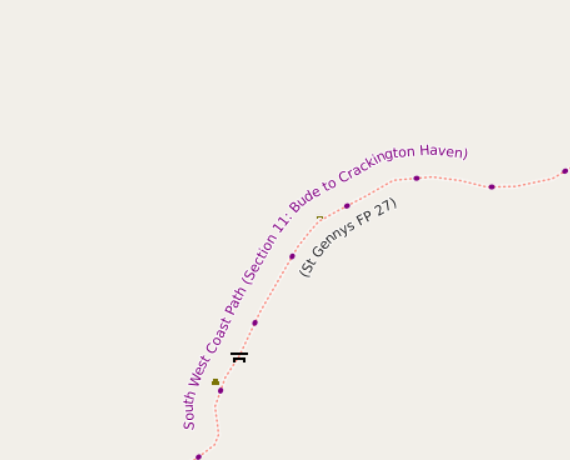
Screenshot of the part of the the Southwest Coast Path, with the silly name of South West Coast Path (Section 11: Bude to Crackington Haven)

I maintain a web map style that shows walking and cycling route names. For the cycle routes, it shows the ref. For some time I’ve massaged some of the names so that e.g. National Byway loops show as “NB (loop)” just like on the signage. However, as can be seen from the example above, some hiking route names are a bit convoluted - they’re more like descriptions than names.

For example, osm.org/relation/3971851 is the England Coast Path. Open up the list of members to see the names, which includes such delights as “King Charles III England Coast Path: Southend-on-Sea to Wallasea Island”. I’m pretty sure that it doesn’t say that on the signs there.

See full entry

Location: Filey, North Yorkshire, York and North Yorkshire, England, United Kingdom

Import dans Openstreetmap des espaces de stationnement de vélos et trottinettes électriques en free floating de la MEL

Contexte

La MEL a depuis mars 2024 lancé un appel à projet (s’inscrivant dans l’Action 34 du Plan de mobilité horizon 2035 ), auquel Lime et auparavant Tier ont répondu pour déployer une flotte de VAE (vélo à assistance électrique ) et de TE (trottinette électrique) sur les communes qui le souhaitent. 68 communes ont répondu favorablement au déploiement du service sur leur territoire.

La détermination des espaces de stationnement se fait de la manière suivante : - Propositions d’emplacements faites aux communes par la MEL au regard de critères d’attractivité, de maillage du territoire, d’occupation de l’espace public. - Avis des communes sur les localisations. - Formalisation des emplacements exacts inscrits dans les arrêtés municipaux d’occupation temporaire du domaine public. - Travaux de marquages au sol réalisés par la MEL après réception des arrêtés municipaux et conformément à ceux-ci.

Précision de la données

Les données de ces espaces de stationnement ont été publié en Opendata en juillet 2024 :

https://data.lillemetropole.fr/geonetwork/srv/fre/catalog.search#/metadata/3b58eafd-19c5-404c-ad90-ed4035535fc7

Le point est normalement précis, il peut y avoir quelques décalages lorsque la station est masquée par un obstacle (arbres, préau) ou lorsque l’entreprise de marquage a décalé son emplacement prévu lors de l’opération de marquage.

Après vérification avec des points connus et l’ortho photo de l’IGN, les points sont assez précis ; après croisement avec les bâtiments, seuls 2 points sur 1300 ont dû être décalé de quelques mètres.

Au total, 1387 espace de stationnement ont été définis.

Les attributs sont également bien renseigné et exhaustif sur l’ensemble du jeux, le champs type_engin permet de distinguer les espaces dédiés au seul VAE et ceux dédié au TE et VAE.

Quels tags choisir ?

See full entry

Location: Lille-Centre, Lille, Nord, Hauts-de-France, France métropolitaine, France
Posted by rphyrin on 18 March 2025 in English.

There’s a saying in a certain article on the OpenStreetMap wiki that “tagging for the renderer” is equivalent to “lying to the renderer.”

Not only that, but the article also restricts the definition and meaning of “tagging for the renderer” as “the bad practice of using incorrect tags for a map feature so that they show up in the mapper’s renderer of choice. Such tagging goes against the basic good practice principles.”

I think that “tagging for the renderer” as a term should first be treated as neutral. On its own, there is no implication that “tagging for the renderer” forces us to lie to the system. Sometimes, people want to do tagging for the renderer simply because they want to place cool symbols around their area in OSM Carto.

Take me, for example.

Several months ago, I decided to download the entire openstreetmap-carto GitHub repository to analyze all of the (cool) icons contained within it and determine which tag combinations were needed to summon such icons on the OSM default map tile.

I found that the charging station icon was really cool. I loved its light blue color scheme, and its visibility on the map tile was quite good—it was already displayed at zoom level 17, on par with bank, gallery, and embassy icons.

I wanted to place this icon around my neighborhood soon. But alas, I didn’t know where any charging stations were located. So I shelved this idea for weeks and months.

Then, during a work trip to Bandung, while walking past the campus I attended as a student several years ago, I finally saw one. A charging station in the wild! It was stationed right in front of the parking area of the Labtek V building.

I was so elated—it felt like finding a legendary Pokémon in the wild! At that moment, I immediately stopped walking, opened Vespucci, and mapped the charging station.

See full entry

UMBRAOSM Brazilian Openstreetmap Mappers Union provides several video classes on its YouTube channel. Access our content and enjoy mapping!

Video lessons for mapping objects in OpenStreetMap.

How to map buildings using the Buildings_Tools plugin in the Josm Editor

https://www.youtube.com/watch?v=nVPdf9MjvjQ

How to map a neighborhood boundary in OpenStreetMap with a custom background layer.

https://www.youtube.com/watch?v=sTe-1N2QvLY&t=2s

How to map in OpenStreetMap with the help of Mapillary images using the ID editor.

https://www.youtube.com/watch?v=dmDW5LhfQpk&t=52s

How to customize the colored painting style to offset street names in the JOSM Editor.

https://www.youtube.com/watch?v=4jOnFjtuI10&t=57s

Enabling remote control and expert mode in the JOSM editor

https://www.youtube.com/watch?v=H8qL_l18f7c

See full entry

Posted by ChicoXXX on 17 March 2025 in Spanish (Español).

Con motivo del Open Data Day de este año invité a diferentes instituciones educativas de la Comarca Lagunera para recibir talleres de mapeo básico entre el 1 y el 7 de marzo.

Logo Open Data Day

El taller “Mapeando tu escuela” lo impartí en:

Espero más universidades se sumen a este evento el siguiente año.

En un reciente análisis publicado en mi blog, exploré la distribución de piscinas en Santa Cruz de la Sierra utilizando datos de OpenStreetMap. La hipótesis detrás del estudio es que la presencia de piscinas privadas puede ser un indicador del nivel socioeconómico de una zona, considerando los costos asociados a su construcción y mantenimiento. Puedes leer más sobre esto en el artículo completo aquí: ¿Dónde están las piscinas?

Densidad de piscinas en la ciudad de Santa Cruz, Bolivia

Previo al análisis, dediqué aproximadamente tres semanas a mapear alrededor de xxxx piscinas en el área metropolitana de la ciudad, utilizando JOSM para la edición de datos. Este esfuerzo fue clave para mejorar la cobertura de OSM en la región y asegurar que la base de datos reflejara con mayor precisión la distribución real de estas infraestructuras. Durante este proceso, utilicé imágenes satelitales (Imágenes aéreas de ESRI mundial).

See full entry

Location: La Adobería, Centro, Santa Cruz de la Sierra, Provincia Andrés Ibáñez, Santa Cruz, Bolivia
Posted by kumakyoo on 14 March 2025 in English. Last updated on 25 April 2025.

Please note: This blog post is part of a series of blog posts about the new OSM file format “OMA”. This is the second post. At the end of the article you’ll find links to the other blog entries.


This time I will give you an example of how to query Oma files. I wrote a prototype of a library for working with Oma files. I called it OmaLibJava.

To explain how to use this library, let’s say, we want to create an overview map of all the power facilities in a certain town.


The Classical Approach

The classical approach with OSM files would be, to first reduce the size of the file by creating a smaller file containing only the data of interest. This is typically done in two steps: remove everything that is not a power facility / remove everything that is not in the town. The order of these two steps is not important for the result, but might have a huge impact on the duration of the process.

Although it is not necessary – or even counterproductive – this can easily be done with Oma files too. For example, the following small Java program extracts all power facilities of Germany:

import java.io.*;
import de.kumakyoo.omalibjava.*;

public class ExtractPower
{
    public static void main(String[] args) throws IOException
    {
        Extractor e = new Extractor("germany.oma");
        e.addExtract(new BlockFilter("power"),"power.oma");
        e.run();
    }
}

Running this program on germany.oma on my computer takes 8.5 seconds. It creates the file power.oma, which is about 22MB in size and contains all power facilities of Germany.1

Let’s have a closer look at the program: the library contains a class called Extractor, which reads an Oma file (here germany.oma) and writes several extracts simultaneously (here only one, called power.oma).

An important part is the filter BlockFilter("power"). This tells the extractor to keep only elements with the key power. I’ll tell you more on filters in a moment. But first I want to show you why you don’t need this step.


See full entry

Objectif

Sur une idée de benoitdd, faire des stats sur les changeset ayant modifié des adresses en France en 2024

Méthodo

Sur OSMCha, préparation d’un filter (une requête) avec :

  • filtre sur la modification de tag addr:street ou type=associatedStreet
  • filtre sur la France
  • filtre sur date pour récupérer 1 seule journée (sinon retour trop gros, pb de timeout + limitation à max 500 changeset dans le retour de toute façon)

Puis avec un script ruby, en utilisant l’api OSMCha :

  • boucle sur les jours du 01/01/2024 au 31/12/2024
  • mise à jour des dates de début date__gte et de fin date__lte dans la requête “aoi” grâce à l’endpoint PATCH aoi_partial_update
  • récupération des changesets grâce à l’endpoint GET aoi_changesets_list
  • lecture du geojson pour extraction en tsv des infos intéressantes

Puis traitement sur excel

Résultats

Le tableur des données brutes est dispo ici : https://lite.framacalc.org/osmfr-adresses-2024-adcm

j’y ai cru mais ça ne marche pas !!!!!

Par exemple le filtrage par type=associatedStreet ne trouve pas les changesets avec des créations de relation, uniquement les modifications, bizarre. Sur un autre exemple, le filtrage par addr:street=* inclut un changeset créant 3 nodes, mais qui n’ont pas ce tag dans leur version #1, bizarre aussi.

Bon, ben on continue avec ces updates relativement au hasard 😅

Ce mappeur OpenStreetMap DÉNONCE certaines mauvaises utilisations de ces panneaux à Seraing - Une petite sortie live écourtée où je montre des panneaux “zone de rencontre” mal utilisés aux Biens Communaux. J’avais prévu quelque chose d’un peu plus long au départ, mais un des panneaux avait été rectifié entretemps et je me suis retrouvé bien con lorsque je l’ai vu sur place 😅

Améliorons Seraing (sur OpenStreetMap) - Épisode 42 (Entre mise au point et trottoirs) - Une session OSM classique qui était plus un prétexte pour parler des derniers mois d’un point de vue personnel et d’annoncer quelques changements prévus pour la chaîne Youtube

Projet OSM #1 : ce mappeur AMÉLIORE le Domaine d’Épinlieu à Mons (sur OpenStreetMap) - Première (et pour le moment seule, j’y viens) vidéo d’un nouveau concept où je prends un quartier ou quoi et montre toutes les modifications que je fais dessus jusque la fin du “projet”

Le “problème” de ce concept est que avant de faire cette vidéo, j’ai effectué un boulot conséquent à Chapelle-lez-Herlaimont pour mettre à jour principalement des bâtiments qui étaient mappés assez sommairement (des rangées de maisons étaient simplement de gros blocs avec aucune adresse, mauvais tags, bâtiments manquants, etc) et ça a pris un bon lot d’updates et évidemment de temps pour arriver à mon but initial. C’est de ce projet hors écran que m’est venu l’idée d’enregistrer certains projets plus modestes pour Youtube et montrer un avant/après.

See full entry

Location: Les Biens Communaux, Seraing, Liège, Wallonie, 4100, Belgique