OpenStreetMap logo OpenStreetMap

Users' Diaries

Recent diary entries

Introduction

During the COVID-19 pandemic, like many others, I found myself immersed in online classes and scrolling through social media during breaks. One day, I stumbled across OpenStreetMap (OSM), and my journey with this incredible platform began out of sheer curiosity. Little did I know that this discovery would eventually lead me to the State of the Map Asia 2024 conference—my first-ever conference application. I cannot express the joy I felt when both my presentation and I were selected to be part of this esteemed event. Though I received only a partial scholarship, I was determined to make it to Cox’s Bazar, Bangladesh. Traveling from Nepal, we were a group of four. I had already booked my flight, which departed from Delhi, while my friends flew directly from Kathmandu.

The Journey to Cox’s Bazar

The journey wasn’t without its challenges. I had a tight three-hour transit in Dhaka to catch my domestic flight to Cox’s Bazar. However, my international flight faced delays, and applying for a visa on arrival meant standing in a long queue. Fearing I might miss my next flight, I humbly requested the visa officer to expedite my process. Time was of the essence, so I couldn’t exchange currency or get a local SIM card. With only minutes to spare, I dashed to the domestic terminal, relieved to find that my domestic flight was also delayed by an hour. I was informed by Sawan Sir that I would meet Hasna Heena and Fazle Rabbi at the airport, which comforted me as they were on the same flight. True to their reputation, the lovely couple warmly welcomed me, helped me exchange currency, and ensured I felt at home upon reaching the hotel.

First Impressions

See full entry

Location: Hotel Motel Zone, Cox's Bazar Sadar Upazila, Cox's Bazar District, Chattogram Division, 4758, Bangladesh

This is my first major mapping project on OpenStreetMap, and I’m calling it the StephenvilleTX Project. I’ve been spending a lot of time refining the roads and overall layout of the city, and it’s been both an exciting and challenging experience. One of my main goals is to improve overall road accuracy before moving on to fine-tuning the local businesses and points of interest.

To help ensure precise positioning, I recently took a drive around Stephenville with my GPS running.
My recent GPS trace helps align the map more accurately than just relying on satellite imagery. Capturing these traces, along with taking my own photos, has been a rewarding challenge, even if it’s hard not to nitpick over every last pixel of road placement.

On the technical side, I’m still learning to navigate JOSM. The learning curve is definitely steep, but I’m enjoying the process and feeling more confident every day. My prior experience doing DoorDash and Lyft around town has given me a strong sense of Stephenville’s geography, and it’s been a huge help in knowing where to refine details and ensure data accuracy.

If any other mappers are working in this area, I’d be happy to collaborate. Need fresh GPS traces or specific location photos? Just let me know. I’m excited to continue improving the map together and creating something that truly reflects the city’s layout and character!

Location: 32.220, -98.202

A Memorable Experience

When I received the news about the State of the Map Asia 2024 in Cox’s Bazar, I was filled with excitement. I was traveling from Chattogram to Cox’s Bazar for this conference was a new adventure. As a Campus Ambassador for the University of Chittagong and a representative of the CUSS YouthMappers Chapter, attending this event was a great honor. The accommodation scholarship I received allowed me to stay at Hotel Prime Park, making the entire experience even more special.

The Journey Begins

The journey from Chattogram to Cox’s Bazar on November 29th was filled with excitement and anticipation. I traveled with one of my friends and three juniors, all of whom were equally excited. Along the way, the scenic beauty of the surroundings made the trip more enjoyable, and we couldn’t help but look forward to what awaited us in Cox’s Bazar. Upon arrival, we were welcomed by the warm hospitality of our hosts, and everything went smoothly. The city of Cox’s Bazar, with its stunning 120 km-long beach, was unlike anything I had ever seen before. The beauty of the sea and the peaceful atmosphere left me in awe, and we made sure to capture some special moments, including drone shots of the beach, thanks to Krishna Prashad Mondal Dada. The entire trip, both to and from Cox’s Bazar, was truly an enjoyable experience.

The Conference Experience

See full entry

Location: Khuruskul, Cox's Bazar District, Chattogram Division, 4702, Bangladesh

On November 30 and December 1, 2024, the breathtaking shores of Cox’s Bazar played host to an extraordinary gathering of mapping enthusiasts, community leaders, and changemakers at State of the Map Asia 2024! This landmark event brought together the OpenStreetMap community to celebrate achievements, share knowledge, and drive the open mapping movement forward. Here’s a glimpse into what we accomplished together:

SotMAsia2024 Photo

Event Highlights

💡 02 Keynote Sessions: We were inspired by two visionary keynote speakers who shared powerful insights and sparked meaningful conversations about the future of open mapping. Their perspectives served as a catalyst for fresh ideas and bold innovations.

🔊 31 Lightning Talks: These bite-sized presentations delivered bursts of inspiration, highlighting unique stories and experiences from mappers across Asia and beyond. Each talk was a testament to the diversity and creativity of our community.

See full entry

Location: Monipuri Para, Tejgaon, Dhaka, Dhaka Metropolitan, Dhaka District, Dhaka Division, 1215, Bangladesh

The Excitement Begins

When I first received the email confirming my scholarship to attend State of the Map Asia 2024 in Cox’s Bazar, Bangladesh, I was overjoyed. It was my first international travel experience, and to make it even more special, it was my first time attending a State of the Map conference. The excitement was real, but so were the nerves. The initial thrill was soon followed by a whirlwind of preparations—official paperwork, visa applications, currency exchanges, and everything in between. At one point, I found myself wondering how I would manage this journey to a faraway country where I didn’t know anyone. But those thoughts soon eased when I knew that some of my friends would be traveling with me. Knowing I wouldn’t be alone made me feel calmer and even more excited for the adventure ahead.

The Journey

The trip to Bangladesh and the onward journey to Cox’s Bazar were incredible, thanks to the warm hospitality of our Bangladeshi friends. They ensured that everything went smoothly, making the entire experience comfortable and enjoyable. Cox’s Bazar was unlike anything I had ever seen before. Coming from a landlocked country, getting a close view of the sea for the first time was simply mesmerizing. The beaches stretched endlessly, and the beauty of the waves crashing against the shore left me in awe. Exploring the city and visiting tourist attractions added an unforgettable charm to my trip.

The Conference Experience

The State of the Map Asia 2024 conference was everything I had hoped for and more. The sessions were packed with valuable insights, showcasing the diverse ways OpenStreetMap (OSM) data is being used across Asia. I attended presentations that highlighted innovative projects from the private sector, government, and civil society, and learned about real-world applications of OSM in humanitarian efforts and disaster risk reduction. The attendees were of every age group from students to experts.

See full entry

Location: Lalitpur-25, Lalitpur, Lalitpur Metropolitan City, Lalitpur, Bagamati Province, 13775, Nepal

Cox’s Bazar, the breathtaking coastal city of Bangladesh, recently hosted the State of the Map Asia 2024 conference. For me, as an enthusiastic mapper, participating in this event was nothing short of a dream come true.

From the moment I entered the venue, I could feel the vibrant energy of the OSM community. The conference brought together passionate mappers, developers, and humanitarian workers, all united by their dedication to open geospatial data. The diversity among attendees—ranging from seasoned experts to curious newcomers—was a testament to how OSM truly belongs to everyone.

The talks, presentations, and workshops stood out as the heart of the event. Participants shared innovative ideas and showcased how OSM is addressing a wide array of societal challenges. These stories of success, coupled with best practices from various communities, highlighted the platform’s versatility and its potential for driving meaningful change.

Equally inspiring were the contributions of the sponsors, who not only supported the conference but also offered valuable insights into how OSM is applied in diverse industries. Their perspectives reinforced the idea that OSM is not just for mappers—it’s a tool for anyone aiming to understand and improve the world.

One of the most rewarding aspects of the conference was connecting with people from across Asia. Despite being an introvert, the friendly and inclusive atmosphere encouraged me to step out of my comfort zone and embrace the sense of community. Every conversation, whether formal or casual, enriched my understanding and reinforced that OSM is as much about collaboration as it is about mapping.

A highlight of the event was the Open Mapping Guru Dinner, an evening filled with meaningful interactions, shared experiences, and celebrations of the collaborative OSM spirit. It was a perfect reminder of how strong and inspiring the global OSM community truly is.

See full entry

Posted by Rabina Poudyal on 14 December 2024 in English. Last updated on 17 December 2024.

Charting New Paths: Insights from SotM Asia 2024

This year, I had the opportunity to attend State of the Map Asia (SotM Asia 2024) in Cox’s Bazar, Bangladesh. While I had previously attended the SotM Global conference, SotM Asia provided a unique and inspiring experience that deepened my engagement with the OpenStreetMap (OSM) community. The conference brought together passionate mappers from all over, each contributing their expertise to solve real-world problems using geospatial data.

As a speaker at SotM Asia, I shared insights on how OSM is being used to improve accessibility to essential services, particularly for women in marginalized communities. The conversations that followed were both thought-provoking and affirming, showing how mapping can be a powerful tool for addressing gender-specific issues.

The workshops and sessions at the conference were incredibly valuable. I gained new perspectives on how emerging technologies are transforming mapping and how they can be applied to address complex challenges. These experiences inspired me to think creatively about the tools and methods I can incorporate into my own work, particularly in my ongoing projects.

Beyond the sessions and workshops, the conference was an opportunity to connect with like-minded individuals. From casual conversations over coffee to the camaraderie at the OM GURU dinner, I was reminded of the importance of community in the open mapping movement. The connections made here will continue to inspire and motivate me as I work on future mapping projects.

Reflecting on SotM Asia 2024, I am deeply inspired to continue my work in the OSM community and beyond. The event reaffirmed the transformative potential of mapping and reinforced my belief in its power to create a more connected, resilient world. I look forward to carrying these lessons into my ongoing work, including the WASH initiative in Birendranagar.

Acknowledgments

See full entry

Location: Banepa-06, Banepa, Kavrepalanchok, Bagamati Province, Nepal

This year, I had the incredible opportunity to attend State of the Map (SotM) 2024, the global conference of the OpenStreetMap (OSM) community, held in the vibrant city of Nairobi, Kenya. As one of the travel grant winners, generously supported by the OpenStreetMap Foundation, this experience marked a significant milestone in my mapping journey. It was my first time at SotM, and I was beyond excited to connect with mappers, developers, and enthusiasts from across the world.

The highlight of my participation was co-presenting the topic “OSM: Spectrum” alongside my fellow mapper Pragya Pant. Together, we shared insights into the diversity of mapping practices in Nepal and the importance of inclusivity within the OSM ecosystem. It was truly empowering to showcase our work on a global platform and engage in meaningful conversations with the audience. The support and enthusiasm we received were incredibly motivating and reinforced the value of collaboration within the mapping community.

One of the most memorable aspects of the conference was meeting so many individuals I had previously interacted with online. Seeing these familiar faces in person was both surreal and heartwarming. The conference served as a bridge, turning virtual connections into tangible friendships. I had the chance to meet mentors and inspirations such as Arnalie and Benedicta whose dedication to OSM has been a source of motivation for me since I started mapping. Their passion and leadership continue to inspire me to push boundaries and contribute meaningfully to the community.

I am also immensely grateful to Mikko, whose consistent support has been instrumental in my mapping journey. Mikko brought together the OSM gurus from Asia before the conference, helping us prepare and connect even before reaching Nairobi. His efforts made a significant difference, and his encouragement continues to inspire me.

See full entry

Location: Tansen--02, Tansen, Palpa, Lumbini Province, Nepal

Mapping My Way to Inspiration: Reflections from SotM Asia 2024

This year, I had the privilege of stepping into a world of boundless ideas and shared dreams as I attended the State of the Map Asia (SotM Asia 2024) in Bangladesh. It was my first time at this prestigious conference, and the experience was more transformative than what I had thought. From the moment I arrived, I could sense the synergy of brilliant minds united by their passion for open mapping and the power of geospatial knowledge. The conference was a melting pot of diverse contributors—youthful innovators with fresh ideas and seasoned leaders whose enduring dedication has shaped the open mapping movement. It was heartening to see how this collective energy is driving solutions for challenges like disaster management and sustainable development. Conversations with participants revealed the exciting role startups are playing, leveraging OpenStreetMap (OSM) data to revolutionize industries and create meaningful societal impact.

As I stood there representing the YouthMappers community, I couldn’t help but feel a swell of pride. My tenure as Vice President of the YouthMappers chapter in 2022-23 had been a defining period, filled with opportunities to lead projects that empowered communities and fostered collaboration on a global scale. Now, as an alumnus, I was honored to showcase the results of our collective efforts. It was a reminder of the transformative power of teamwork and the potential of mapping to change lives.

See full entry

Hallo zusammen,

wie Ihr sicherlich wisst, kann es bei einer Way-ID häufig vorkommen, dass mehrere parking:restrictions vorkommen. Bisher habe ich immer die Information erhalten, dass eine präzise Zuordnung nur möglich ist, indem die Way-ID in mehrere Segmente aufgeteilt wird.

Ich bin auf diesen Wiki-Beitrag zum Thema “mehrere Werte für einen Key” gestoßen und frage mich, ob dieser Ansatz noch aktuell ist und in der Praxis verwendet werden kann. osm.wiki/Multiple_values

In meinem ersten Versuch habe ich parking:restrictions mit mehreren Werten in einem Tag eingetragen. Dies wurde jedoch kommentiert, dass die meisten Anwendungen dies nicht unterstützen. Hier der entsprechende Kommentar: osm.org/changeset/159989249#map=19/50.114737/8.679454

Seitdem habe ich diesen Ansatz nicht mehr verwendet. Gibt es alternative Möglichkeiten, um mehrere Einschränkungen an einer Way-ID korrekt und zugleich möglichst genau zu erfassen, ohne die ID zerschneiden zu müssen?

Ich freue mich über Eure Hinweise und Ideen!

Vielen Dank und viele Grüße Simon

Most people these days prefer flattery to doing good. Because flattery helps people to reach their goals very quickly. And this practice is increasing day by day in open communities. Due to which, day by day, open tools are closing down without being able to keep up with time.

How many other tools are open/free related to OpenStreetMap?

If it continues like this, it will just turn into garbage one day.

Everyone will chant until his own interests are saved, after which people will leave this too.

আজকাল বেশির ভাগ মানুষ ভালোকিছু করার চেয়ে চাটুকারিতা বেশি পছন্দ করে। কারণ চাটুকারিতা মানুষকে খুব তাড়াতাড়ি তার অভীষ্ট লক্ষে পৌছাতে সাহায্য করে। আর ওপেন কমিউনিটিতে এই প্রাকটিস দিন দিন বেড়েই চলছে। যার কারণে দিন দিন ওপেন টুল গুলো সময়ের সাথে পাল্লাদিয়ে টিকে থাকতে না পেরে বন্ধ হয়ে যাচ্ছে।

ওপেন স্ট্রীট ম্যাপের আর কয়টা টুল ওপেন আছে ?

এমন চলতে থাকলে এটা শুধুই গারবেজ এ পরিনত হবে একদিন।

সবাই তার নিজ নিজ সার্থ উদ্ধার হওয়া পর্যন্ত গুনোগান করবে এর পর এটাকেও মানুষ ছেড়ে দিবে ।

Posted by b-unicycling on 11 December 2024 in English. Last updated on 1 January 2025.

So, about 6 weeks ago, I met someone who teaches at Simpson College in Indianola, Iowa at a conference here in Ireland. This made me curious about Indianola, and I went to check it out on OSM. Anything could trigger that in me.

I found the campus fairly well mapped with most of the buildings and most of the highway=sidewalk and some trees mapped, but there was more to be done. So, I started off easy with some footpaths, trees and missing buildings, but then I got competitive and wanted to see how long it would take be to get into the list of mappers for the US of A in the OSM stats.

That took me much longer than expected, because I’m used to get onto those lists fairly easy having mapped in much smaller countries with far fewer active mappers. But after about two weeks (I don’t remember exactly), I was in the Top 500. Yee-haw!

As of this morning, I was #160 which is not so bad, considering I “had to” hold my #1 in Ireland and stay in the Top 20 in the UK.

See full entry

Location: Indianola, Warren County, Iowa, 50125, United States
Posted by DeBigC on 10 December 2024 in English. Last updated on 11 December 2024.

Here I go again…. part 2.

I was pleased to see someone pick up on my first diary item. OSM weekly is hardly the New York Times, yet I know that the editors like posts which are constructively critical, and they did spot that I was hoping for something to happen which would let us all “do better”.

I decided to look in more detail at how the lack of detail was leaving validators with a lot of mapping to do. Evidence of this is seen here, where the mapper marking the tile as “completely mapped” is nowhere near being the main contributor of objects and the validator – DeBigC – has add or adjust 62% of the objects in the tile. This shows the last mapper to touch any object. Screenshot-2024-12-11-112534 Note: I do accept that this is one tile, but it’s not unusual to find this all over the Fingal task.

See full entry

As a friend and I were adding the 57th tag to a climbing gym in Belgium, I wondered what the element with the highest tag count is. I couldn’t find such stats (which may be a good thing), so I downloaded belgium-latest.osm.pbf from Geofabrik and wrote a simple Python script that uses Pyosmium to do some counting for me.

Without further ado: the Belgian record for highest tag count is… the relation for Belgium itself actually, which currently has 491 tags. The non-relation with the highest tag count is, boringly, the node for Belgium, with 288 tags. Next up are Brussels (156 tags), the Council of the European Union (79 tags), one particular section of the River Meuse that somehow got its name mapped in 57 different languages (65 tags) and the Irish embassy (also 65 tags). Next up is the first element that has a lot of tags not because it’s just flooded with languages! This maritime beacon north of Antwerp in the River Scheldt has a respectable 63 tags to describe all its lights. Our climbing gym is not far off from this one, and has a lot more diverse information in its tags I’d say.

I noticed that the relation for Belgium also has a high version number, it’s at its 1043th revision. That prompted me to take a look at version numbers too. But 1043 isn’t even close to our record, which goes to the superroute relation for the E40 (version 3141). Granted, that’s international. The version record for a purely Belgian object is the hiking route GR 126 (version 1103) from Brussels to Membre-sur-Semois. Just like with tag counts, I find it more interesting to look at non-relations here, though. There the honour for highest version goes to one of the outer rings of a farmland multipolygon south of Mons, which is at version 277. Funnily enough, in contrast with its senior version number, it almost has no tags to speak of, only a source!

See full entry

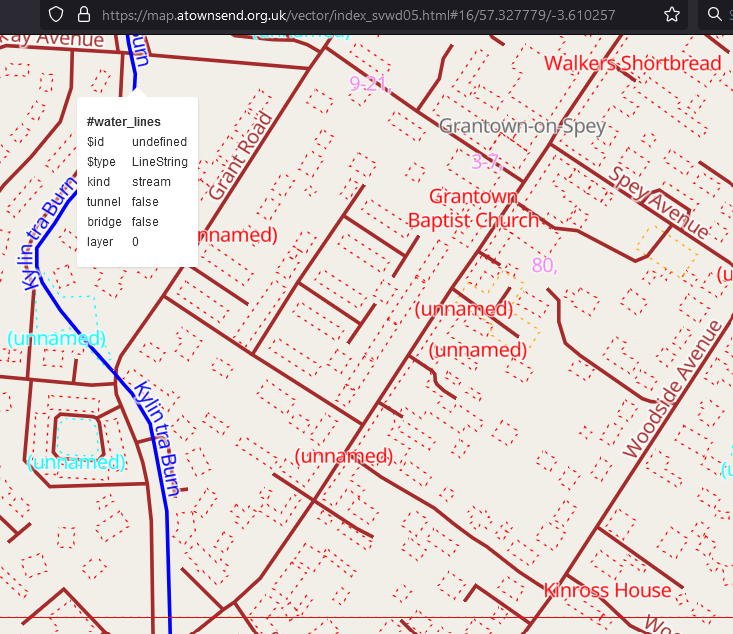
Screenshot of the svwd05 map style, showing a Walkers Shortbread shop in Scotland

I created this for my own use, but am sharing it here because it might be useful to other people too. This is the style and there’s a brief readme.

It uses different colours to highlight different map layers. It’s not supposed to look nice; just to show you what is there.

I believe that everything described in the schema is included. If a feature does not appear it might be because:

  • it’s not in the Shortbread schema.
  • it’s in the schema, but is for some reason missing from the OSMF vector tiles.
  • it’s in the tiles, but there’s a bug in this style.

There are lots of features in the first category, and there seem to be a couple in the second. If anyone finds anything in the third category please let me know!

Location: Inverallan, Grantown-on-Spey, Highland, Scotland, PH26 3NS, United Kingdom
Posted by sangonzag on 7 December 2024 in Spanish (Español). Last updated on 24 December 2024.

Últimas contribuciones

¡Ya la vereda Cascajo Abajo se encuentra totalmente mapeada!

He tardado un montón de días mapeando esta vereda, en parte porque hubo semanas en las que no cointribuí al mapa, y porque es una vereda considerablemente grande.

Consideraciones

He estado pensando en la posibilidad de usar DAMN para seguir con el proyecto de mapeo de Marinilla. Aunque la infraestructura del Tasking Manager de HOT es muy conveniente, y la Comunidad OSM Colombia ha sido lo suficientemente amable conmigo como para dejarme alojar este proyecto en el grupo de Colombia, considero que sería apropiado migrar a una alternativa “individual” de mapeo organizado. Aún no estoy muy familiarizado con la herramienta, y valdría la pena empezar a hacer pruebas. Por el momento, la próxima vereda (La Esmeralda) se va a montar en los próximos días en el Tasking Manager. Espero que para la vereda número 4 o 5 ya pueda migrar a DAMN, si lo considero viable.

Sostenibilidad

Creo que el proyecto, tal como se ha venido desarrollando, es un poco insostenible. Uno de los elementos principales de OSM es la posibilidad de trabajar en comunidad. Por ahora, esto ha sido un esfuerzo primordialmente individual, y no me gustaría que se mantenga así por mucho tiempo. Por varias razones: * No es humanamente posible (por lo menos en un tiempo razonable) mapear todo el municipio por mi cuenta. * Me gustaría poder convocar a la comunidad de Marinilla y de otras partes del país para que ayuden a tener mapas urbanos y rurales consolidados.

See full entry

Location: Cascajo Abajo, Marinilla, Oriente, Antioquia, RAP del Agua y la Montaña, Colombia