OpenStreetMap logo OpenStreetMap

Users' Diaries

Recent diary entries

Este é o quarto entre os diários de campo que compõem o caderno de campo da minha pesquisa sobre interações sociotécnicas nos Altos e Córregos da Zona Norte do Recife e sua área contígua em Olinda, cidades localizadas na Região Metropolitana do Recife (RMR). Mais detalhes sobre a pesquisa vocês podem ver na minha tese de doutorado, publicada em https://repositorio.ufpe.br/handle/123456789/48802. Para a tese a delimitação socioespacial foram os Altos e Córregos da Zona Norte do Recife, a parte de Olinda foi agregada depois da tese.

Os diários de campo foram realizados em minhas idas ao território objeto de estudo. Nessas idas sempre registrei o percurso com o aplicativo OSM Tracker. Esse diário diz repeito a ida para a sede da EScola Pernambucana de Circo, no Alto do Burity, Recife/PE http://u.osmfr.org/m/757844/ .

alt=track do percurso realizado neste campo

Segue abaixo o diário de campo na íntegra, apenas com alterações de nomes pessoais, com o intuito de resguardar a identidade das interlocutoras:

See full entry

Location: Macaxeira, Recife, Pernambuco, Região Nordeste, Brasil

I made a Chrome extension (which should be compatible with all Chromium-based browsers) and Firefox Add-on that hooks into the osm.org Edit buttons and redirects it to Rapid. Also, it integrates Strava heatmap support into Rapid as overlay imagery.

It’s an early version, and I’m sure there’s bugs, so please open issues (suggestions welcome too): https://github.com/emersonveenstra/rapid-power-user-extension/issues

Also, for those wondering, I am jumping back into osmdiscussiontracker development soon, I just needed to scratch this itch first :)

Happy mapping!

EDIT THE CONSENCOUS HAS NOW CHANGED TO SAY THAT THIS DATA IS REMOVED BECAUSE OF A UNDOCUMENTED IMPORT WHICH IS EXACTLY THE REASON I SAID IT SHOULD HAVE BEEN REMOVED UNDER NOT BECAUSE OF A COPYRIGHT VIOLATION

context https://community.openstreetmap.org/t/apparent-use-of-unauthorised-source-for-beach-names-in-australia/108721

The names of our beaches is open and public data in Australia, the names of our beaches have been deleted for no reason at all.

this removal was based on a unofficial chat room discussion which is not documented for anybody to see.

the surf life saving club does not own the right to the names of our beaches, however granted the the surf life saving club may not the the most direct source of this information. but we have a full waiver to use this information none-the-less from our government.

there was never a formal proposal about the removal of this information

along with this massive deletion was other information such as boat ramps and beaches drawn in clearly by using imagery.

posting here because my comments keep getting removed by the moderators now.

Welcome to the thirteenth OpenStreetMap NextGen development diary.

🔖 You can read other development diaries here:
osm.org/user/NorthCrab/diary/

⭐ This project is open-source — join us today!
https://github.com/Zaczero/openstreetmap-ng

🛈 This initiative is not affiliated with the OpenStreetMap Foundation.

In case you missed it…

Last week, we showcased Search 2.0: a comprehensive overhaul of the search functionality. For the first time, OSM search is now simple and intuitive to use. It’s a must-see (there’s a video too)!

Default Editor Switching

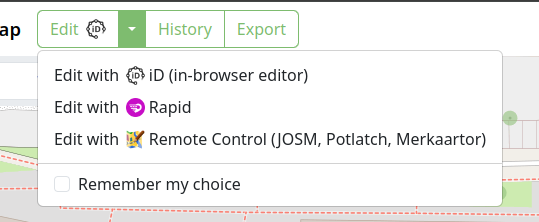
This week, OpenStreetMap-NG introduced a convenient way to change your default editor. By exposing this functionality, previously hidden in settings, we prevent editor lock-in and allow users to easily experiment with other editors. A small icon now indicates which editor is currently set as default.

Faster and Slimmer GPX Traces

We completed a major overhaul of the GPX trace database design. Here are the results:

See full entry

Hi! This is Faiza Waziha. One of the Gurus of the Open Mapping Guru Fellowship. This journey started when I was selected to be a part of this incredible journey in 2023.

First of all, I want to mention the vibes this community gives. It is very welcoming, energetic and inspiring. I love the enthusiasm so much!! This is one of the reasons I get to learn so much from them and to communicate with them without worries.

There were 3 tracks in the fellowship (Training, Mapping, and Validation). I was part of the Mapping track. After getting the briefing about what we will be doing for the next 5 months, I was pumped up for the challenges. We got to map various countries; India, Bangladesh and also some Island countries like Tonga, Vanuatu, and Micronesia. Which were very interesting and got learned many geological characteristics of those areas.

From this fellowship, I have learned to use Josm (It is the most efficient thing a mapper can have to map anything and I love it!!), Mappilary and Everydoor. Also the use of Josm in validation, how to use the open data source for data analysis in QGIS. These skills will help me in building my career as a GIS analyst.

This fellowship allowed me to connect and communicate with many talented individuals like Brazil Singh Rittik Vai, Khan Mohammed Ibtehal Vai, Can Unen and many more. It was also a great experience to be a part of Slum area mapping in Mirpur in collaboration with World Vision Bangladesh. I get to lead an amazing team- Sozin’s Comet in the Climate Change Challenge 2024. Though we didn’t win any prizes it has helped me a lot in how to manage a team, how to stay motivated and keep others motivated. I learned that communication is the key to leadership. I have grown as a mapper and also a better human being.

Lastly, I want to thank Mikko Tamura, and Honey Fombuena for their immense support and for pushing us to reach our goals. Thank you so much!!

Location: Pallabi 2, Pallabi, Dhaka, Dhaka Metropolitan, Dhaka District, Dhaka Division, 1216, Bangladesh

Sometimes I think I’m a bottom feeder going through the map and cleaning up the obvious errors and this comes from my observations over time and cleaning up thousands of duplicate buildings.

Because many countries do not have good census data you can do a rough calculation by multiplying the number of houses by an average number of people who live in them. It isn’t perfect but if you have nothing better then it works.

So duplicate buildings are a problem. When you’re looking to see how many schools you need duplicate buildings mess the numbers up. Buildings incorrectly tagged or not tagged at all also mess the numbers up.

Then we get to the imagery used. These days I’m seeing more and more microsoft BuildingFootprints tags on buildings. They are normally very accurate and align well with Bing imagery. The largest most accurate satellites are only accurate to 60 meters so the imagery has to be aligned. My recommendation would be to use Bing imagery and find a building that aligns with it. Then switch to your preferred imagery and align it with the Bing aligned one.

This helps ensure that buildings are only mapped once and when you add buildings you don’t add an existing building and if someone imports using microsoft BuildingFootprints then your building won’t be remapped 10 meters away in the future.

Disposable mappers are often used meaning many will only may a few times. So we don’t really have time to train them.

We want to get the most accurate mapping we can from them and as many buildings as we can. With JOSM buildings_tool plugin I can highlight one building then add more by clicking and holding down the button, moving to the opposite corner of the building and releasing the mouse button. If they aren’t in line it takes another mouse button click. You get a rectangular building correctly labelled. This is far less than using iD. Plus you don’t need a validator to inspect each one to see if it is correct.

See full entry

Posted by Pisto81 on 30 June 2024 in English.

Well, the fellowship was the first of its kind for me. The whole time, the commitment led me to learn and know the vast features and tools of OpenStreetMap. The fact that overwhelmed me most that how the organization has managed and engaged numerous volunteers and improved its tools over time. Training and resources were efficient and convenient in a structure that proved instrumental for me in completing the tasks. The biggest delight is seeing my edits come into visualization within moments which truly instills a feeling that I am making an impact by mapping. Throughout the whole time, I have been able to discover a little of it and may also have made slight and/or big mistakes during edits or validation, ahead of this, I want to explore this platform more and be an instrumental mapper.

Posted by Thelone1986 on 30 June 2024 in French (Français).

On va essayer de faire des updates mensuels à partir de maintenant 😉

Que dire sur ce mois de juin? J’ai continué à laisser OSM me guider là où ça me plaisait plutôt que rester du côté de Seraing et ses environs proches (non pas que Herstal soit à l’autre bout du monde cela dit 😁). La première vidéo cependant est sur une zone que j’avais faite récemment, mais qui avait une situation un peu confuse que j’ai vérifié sur place, et donc :

Ce mappeur OpenStreetMap EXPOSE LA VÉRITÉ sur cet ancien quartier près de l’aéroport de Bierset - Voici la vidéo que j’ai prise quand je me suis rendu dans le coin en question. La confusion venait du fait que les anciennes rues de ce quartier sont toujours visibles sur le PICC à l’heure actuelle (et l’avenue de la miniature est elle toujours sur les images satellite les plus récentes disponibles ici sur OSM) alors que cette zone est maintenant une énorme zone en friche pour faire simple

La vidéo suivante est le résultat d’un article sur le site de la ville de Seraing qui annonçait de nouveaux travaux pour…

Améliorons Seraing (sur OpenStreetMap) - Épisode 38 (La liaison manquante du boulevard urbain) - Version live de ce changeset où je mappe les travaux et le futur tracé en gros

On retourne ensuite à Herstal (que je n’ai pas vraiment “quitté” cela dit hors caméra) pour…

Ce mappeur OpenStreetMap DÉPLACE UNE DALLE (avec une 🖱️), mais pas seulement! - Sous ce titre ridicule se cache ce changeset où je corrige et remets à jour toute un quartier qui en avait bien besoin

À partir d’ici, j’ai commencé à utiliser le tag “footway=alley” pour désigner plus précisément les petites allées piétonnes qui passent derrière des habitations dans certains quartiers. De nouveau, ça me fait “voyager” un petit peu dans la région liégeoise et j’ajoute/corrige d’autres choses dans le même temps, ce qui nous amène à…

See full entry

Location: Le Pairay, Seraing, Liège, Wallonie, 4100, Belgique

The Importance of Community Mapping

Over the past two decades, in particular, mapping has become open access, since map data is increasingly used to support society facing crisis. As this goal gained momentum, a community-driven mapping interface emerged in 2003. Open Street Maps pioneered the way for easy updating and access to map data at your fingertips.

It was a marvel back then, and these mapping tools paved the way for Crowdsourced Mapping after the catastrophe in Haiti in 2010. However, there is still a large human resource deficit that can only be satisfied if we make OSM knowledge prominent throughout institutions and schools alike, as was cultivated in the OSM Guru Program during in-person training at JNTU, Hyderabad.

See full entry

Location: Ward 114 KPHB Colony, Hyderabad, Kukatpally mandal, Medchal–Malkajgiri, Telangana, 500085, India
Posted by JoshuaOrais on 30 June 2024 in English.

OM Guru

From a casual interest in maps to fully diving into the depths of community mapping and data validation, that is how I can describe my OpenStreetMap journey up to this point.

Programs conducted by the YouthMappers Network, Humanitarian OpenStreetMap Team, and the Open Mapping Hub Asia Pacific taught me everything I know in the field of open mapping. These programs continuously introduced me to the wonders of the geospatial field, from the creation of maps to real-world applications of open spatial data; and they consistently piqued my interest, driving me to learn even more. When the opportunity came to be one of OMHAP’s Open Mapping Gurus, I was ecstatic. It was a chance to learn from the best and most experienced people in the field and an opportunity to help the community—the core value of being an open mapper.

See full entry

Me, MySelf and OM Guru Fellowship

Hello Fellas! Greetings from Indonesian Mapper.

Okay, I believe this is my first diary entry as I start contributing to OpenStreetMap. I’m not sure how many people will be interested in reading my diary, but I’ll share my story here.

“Above the sky, there is still sky” - it’s a quote we’ve probably heard before. OpenStreetMap is made up of many contributors from around the world, all of whom are great mappers and work diligently for the world. I realize that the knowledge I have now must have been possessed by several people before me. Because of this, I feel that with OpenStreetMap, I can learn and collaborate with other mappers.

Just a quick flashback to 2019 when I made my first contribution to OpenStreetMap. At that time, I was still unsure of what OpenStreetMap was. I thought it was just a mapping tool and had no idea about the many surprises it held.

As a geography student, mapping is my passion, and I enjoy contributing to OpenStreetMap. To my surprise, I became the best mapper in a competition held by OpenStreetMap Indonesia. In 2021, I was the only Indonesian participant in the HOTOSM internship. The following year, I was hired at OpenStreetMap Indonesia (POI), and now I am part of the OM Guru Fellowship program. The Om Guru gives us tasks to work on each month, I am responsible as a validator, where the tasks given to me are things related to validation. I carry out validation using quite a lot of media such as OSMCha or OSM Inspector, of course, this adds to my knowledge and skills.

“For me, by consistently practicing and loving what we do, we will invite miracles into our lives”.

See full entry

Location: RW 03, Petojo Selatan, Gambir, Central Jakarta, Special Capital Region of Jakarta, Java, 10160, Indonesia
Posted by roxystar on 29 June 2024 in English.

Munich Trudering shines – München Trudering leuchtet

Fascinated by the conceptual work and the impressive renderings of the “MASTERPLAN BELEUCHTUNGSKONZEPT FREIHAM NORD” <1> I was wondering if one would be able to “re-engineer” the existing reality of a city or a city district by means and capabilities of Open Street Map in order to finally achieve a rendering similar to <2>.

First steps

OK, I thought, let me try to find out. I started to walk through the streets of my neighbourhood identifying and positioning street lamps with the tool EVERY DOOR. As always the devil is hidden in the detail. How to determine height? Typically in the early evenings (I order to see the laser dot), I started to measure the distance from street level to lamp body with an of the shelf laser instrument (BOSCH Zamo 3). This worked quite well in not so busy streets however I did not had the guts so far to do a measurement in one of the main streets with constant traffic especially when the lamp poles are located at the center of a 4 lane street. I need to find an alternative solution for those cases. Height is one of the most important parameters for illumination.

I was made aware by a very helpful OSM member <3> that there is a moving map renderer <4> to display exactly the kind of rendering I was looking for. It turned out that this tool is becoming my most important tool for quality control. Gaps and irregularities in “lighting” and referencing are very easy to identify.

“Picture 1”: Current progress for Munich Trudering.

Next steps

See full entry