OpenStreetMap logo OpenStreetMap

Users' Diaries

Recent diary entries

Posted by jbcharron on 8 March 2025 in French (Français). Last updated on 11 March 2025.

Contexte :

Les données existantes :

  • Comme pour le réseau électrique, le réseau gazier a commencé à être intégré dans OpenStreetMap il y a plus de dix ans, avec comme sources l’imagerie Bing ou le Cadastre pour identifier les stations de compression, les stockages souterrains de gaz et les artères principales du réseau.
  • Il y a environ 7 ans lors de la mise à disposition du tracé des réseaux en OpenData et l’amélioration d’année en année de la qualité des vues aériennes, la cartographie s’est intensifiée permettant d’affiner le tracé du réseau, d’ajouter les tronçons de conduites manquantes, d’identifier les bornes jaunes dans le paysage ou encore d’ajouter les sous-stations gaz de distribution.
  • Les différentes propositions réalisées pour ajouter, modifier ou déprécier des tags sur les réseaux transportant des fluides (Proposition pour décrire les vannes ou la proposition pour améliorer la cartographie des bornes) ont permis de faire un « entretien » régulier et d’enrichir les données de façon continue.
  • Du fait que le sujet des réseaux gazier est moins connu par la communauté OpenStreetMap que d’autres sujets comme les réseaux électriques, les contributeurs ont parfois utilisés des tags assez génériques ou peu adaptés pour décrire les installations.

Exemples de tags utilisés pour décrire les sous-stations gaz :

See full entry

Posted by darkonus on 8 March 2025 in English. Last updated on 9 March 2025.

As an OpenStreetMap contributor, I always pay attention to how maps are used in media and various software applications. It is fascinating to see OSM data appear in unexpected places. Previously, I noticed that OpenStreetMap was used in the movie Mission: Impossible.

Recently, I came across an example of OSM’s osmCarto style being used in the software of the Skyranger 35, a highly mobile air defense system.

osm-carto

See full entry

Open Data Day 2025: Mapeando el Futuro de la Educación en Casanare

Hoy celebramos el evento Open Data Day 2025 en la Universidad Internacional del Trópico Americano (Unitrópico), junto a mis compañeros del capítulo de YouthMappers en el área de cartografía. Bajo la dirección de la ingeniera Doris Ruiz, nos centramos en el uso de herramientas como OpenStreetMap para llevar a cabo actividades de mapeo colaborativo, contribuyendo a hacer frente a la policrisis que enfrenta nuestra sociedad. Foto del ecneuntro Nuestro objetivo principal fue mapear la infraestructura de las instituciones educativas en el departamento de Casanare. Este mapeo incluyó no solo los edificios, caminos y vías, sino también áreas naturales como jardines, árboles, prados y otros elementos. A través de OpenStreetMap, pudimos identificar múltiples áreas y elementos, empleando técnicas de fotointerpretación con las imágenes de **BING y ESRI disponibles en la aplicación.

See full entry

Location: Comuna 3 - Clelia Riveros, Perímetro Urbano Yopal, Yopal, Casanare, RAP Llanos, 820000, Colombia

Open Data Day 2025 en Colombia

En Colombia, por segundo año consecutivo, se celebró el Open Data Day, esta vez en su edición 2025. Seis ciudades participaron en el evento: Pasto, El Carmen de Viboral, Ipiales, Yopal, Pore y, por supuesto, Villavicencio, Meta.

En esta ocasión, el 6 de marzo de 2025, se llevó a cabo una jornada de mapeo junto con estudiantes de la Universidad de los Llanos (Unillanos), para muchos de los cuales era su primera experiencia en este tipo de actividad.

Mapeando Unillanos

Objetivo del mapeo

Este año, el objetivo del mapeo fue identificar y registrar puntos de interés en instituciones educativas, permitiendo a los estudiantes comprender el papel fundamental que juegan las escuelas y centros educativos en contextos de crisis humanitarias, desplazamientos forzados y desastres naturales. Históricamente, estas instituciones han servido como refugios temporales para las víctimas, brindando apoyo mientras se encuentran soluciones para su retorno a sus territorios.

See full entry

Location: Barcelona, Villavicencio, Meta, RAP (Especial) Central, Colombia

Cette entrée a pour but de répondre à une question posée sur le forum, mais rédigée pour donner plus une vue d’ensemble de l’activité qu’une simple description des méthodes.

Appréciant particulièrement la micro-cartographie, les cheminements des piétons ont naturellement fait partie de mes préoccupation depuis presque les débuts de ma contribution. Mais la tâche était immense (surtout pour une agglomération de la taille de celle où je résidais alors) et je ne passe pas tant de temps que ça dehors avec un ordiphone à la main…

Groupe local et évolutions techniques

Mais depuis, plusieurs choses ont évolué.

J’ai découvert StreetComplete, qui contient plusieurs quêtes sur les trottoirs et passages piétons (en particulier l’accessibilité de la bordure entre l’un et l’autre). Plusieurs utilisateurs au sein du groupe local angevin utilisent StreetComplete — notamment Sébastien Chopin, qui sillonne littéralement l’agglomération.

En particulier, ces utilisateurs qualifiaient le filaire là où il existait déjà et ne pas avoir cette possibilité partout en fonction des filaires créés ou non était dommage.

D’autre part, la qualité des orthophotographies disponibles s’est nettement améliorée, les trottoirs et passages piétons étant généralement parfaitement visibles.

Et enfin, le groupe angevin est plutôt intéressé dans l’ensemble aux questions d’accessibilité. Sébastien Chopin — toujours lui — entreprend même des démarches d’acquisition de matériel spécifique.

Débroussailler

Dans ce contexte, la cartographie à grande échelle des cheminements piétons est redevenue un de mes sujets d’intérêt.

J’ai donc commencé à planifier une modification d’envergure sur la commune d’Angers pour ajouter autant de filaires de trottoirs et de passages piétons que possible à partir des imageries disponibles.

See full entry

Location: 47.476, -0.556
Posted by kumakyoo on 7 March 2025 in English. Last updated on 25 April 2025.

Whenever I use files containing OSM data, I’m faced with two major problems. These problems are inherent in the OSM data model and inherited by the common file formats (.osm, .o5m, .pbf).

The first of these problems is about accessing the data: As a result of the data model users are forced to use either huge amounts of memory or a lot of time. Often even both.

The second problem is even worse: Quite often you have to guess properties of the data, which means using heuristics. But by their very nature, they can lead to wrong results. The most prominent example is probably the question, if a closed way element represents a linear object or an area.

To overcome these problems I invented a new file format. The main idea: Convert the data once (accepting the drawbacks caused by the two problems) and end up with data that can be processed fast, using only little memory. I also tried to keep the file size small and the file format simple.

I called the new format “OMA format” like “Open MAp”. It’s accompanied by a human readable version called “OPA format” like “Open PAper”. (Oma and Opa are the German words for grandma and grandpa).

It took me about a year to design the Oma file format, and write a converter and a library for querying the new file format. I still consider it in experimental state, as I would like to get some feedback before releasing a stable version. Hence this post.

All this is a lot of stuff and I can’t go into all the details in just one blog post. For this reason I’ve decided to keep this article brief and base it on a single example. In the coming weeks, I will be writing more articles about the new file format, which will provide more in-depth information.


Scattered Data in OSM Files: The Viktorstraße in Wuppertal

See full entry

My personal enemy that I take so serious, is someone who edits an area on a map as “under construction” and then it SITS for longer than 6 months in that stage. In some cases people have been living in that neighborhood for 3 years…and it’s been marked as “under construction.” Here I am today fixing areas that are fully developed now, fully established- and the average of the construction edits were made 2 years ago. Here’s hoping doordash, my personal use favorite Strava, or even pokemon go run an update for those poor folks.

This is purely a diary rant about residential areas and their roads not being updated. I almost wish there was a way to make “under construction” just be something for an existing thing being updated/fixed, not something being built. We’re mapping what’s there to be mapped. I’d rather new developments or roads have like a “coming soon” tag of some sorts that wouldn’t block in app access.

We can use strava as an example, i’ll set a route and it’ll make me avoid an entire neighborhood because “Deleted User” 3 years ago marked these 7 streets near the lake trail as “under construction.” Took me a sad amount of time, admittedly, to realize what was happening. Another example is Niantic not having in game spawns (pikmin, pokemon, ingress) if an area is marked “under construction” because the game labels the area as dangerous, so why would they give server room to RNG spawn their in game items there? Reality though is Ash can and SHOULD be able to catch his Pikachu there because he’s been living there for 3 years- Niantic just doesn’t think it’s safe.

So, here’s my little rant about the amount if neighborhoods i fixed today that i have personally been to, biked through, walked my dog through, that have been “under construction” the last 28 months.

Location: Eagle Mountain, Utah County, Utah, 84005, United States

Hoy desarrollamos nuestro evento Open Data Day 2025: Escuelas en el mapa, un camino a la resiliencia en la Institución Educativa Ciudadela de La Paz, en Pasto, Nariño. Por segundo año consecutivo, desde el capítulo YouthMappers SAGEMA, apoyamos el diseño metodológico de la participación de la comunidad OSM Colombia en el Open Data Day, esta vez con un enfoque en el uso de datos abiertos en entornos educativos. Registro de los estudiantes en OSM

Junto a los estudiantes de grado 9, recorrimos la institución utilizando Mapillary, demostrando su importancia como herramienta para capturar imágenes inmersivas y mejorar la visibilidad de la infraestructura escolar. También empleamos Field Papers para mapear la distribución de espacios clave como baños, laboratorios, oficinas, salones, caminos, el restaurante escolar y la tienda.

See full entry

Location: Comuna 10, Perímetro Urbano Pasto, Pasto, Centro, Nariño, RAP Pacífico, Colombia

– Read in English

Mapeamento de árvores no OpenStreetMap e palestras especiais


O evento será realizado em 31 de março de 2025, com atividades presenciais e remotas, pensadas para despertar para a importância dos dados abertos na dimensão ecológica, para fins de colaboração para a conservação ambiental e a melhoria da qualidade de vida dos habitantes, frente às consequências evidentes da crise climática, que têm piorado as condições ambientais nas cidades e levado ao aumento da pressão por recursos, especialmente, os energéticos.

🌳🌳🌳🌳🌳

Serão concedidos dois certificados independentes (manhã/noite) Inscreva-se até 30 de março de 2025, 23h59 (UTC-3). Vagas limitadas (20) para a atividade presencial (manhã). Para a atividade da noite, sem limite de vagas. LINK DE INSCRIÇÃOPágina do evento

🌳🌳🌳🌳🌳

poster

See full entry

Since the end of 2019, the OpenArdenneMap map style has been updated on ~~a six-monthly cycle~~ from time to time. OpenArdenneMap is an open-source cartographic style for topographic maps based on OpenStreetMap data. The ‘winter 2024-25’ release has just been published.

That’s mainly small improvements in the QGIS-style that have been made. OpenArdenneMap is available for Mapnik (a software used mainly to create map tile servers) and QGIS (a more general GIS software).

In particular, there has been the addition of the ‘marked trails’ layer, which was still missing in the QGIS style. To add the marker to the map (the equivalent of the shield in Mapnik), we use a combination of 2 ‘Marker Lines’, with the superimposition of an SVG marker for the marker and a character (Font Marker) for the number often inscribed in the marker.

I have also added a map layout to the QGIS project file, which allowed to update an existing map on hiking.osm.be, for the map of Herbeumont.

OpenArdenneMap extract for Herbeumont

See full entry

Location: Herbeumont, Neufchâteau, Luxembourg, Wallonie, Belgique
Posted by Raquel Dezidério Souto on 6 March 2025 in English. Last updated on 27 March 2025.

– Em Português

Fieldwork for mapping trees with OpenStreetMap and special lectures


The event will be held on March 31, 2025, in Portuguese, with fieldwork and remote activities designed to raise awareness of the importance of open data in the ecological dimension, in order to collaborate in environmental conservation and improve the quality of life of inhabitants, in the face of the obvious consequences of the climate crisis, which have worsened environmental conditions in cities and led to increased pressure on resources, especially energy.

🌳🌳🌳🌳🌳

Two independent certificates will be awarded (morning/evening) Register by March 30, 2025, 23:59 (UTC-3). Limited places (20) for the fieldwork activity (morning). Unlimited places for the evening activity. REGISTRATION LINKEvent page

🌳🌳🌳🌳🌳

poster

See full entry

Posted by lonvia on 6 March 2025 in English. Last updated on 8 March 2025.

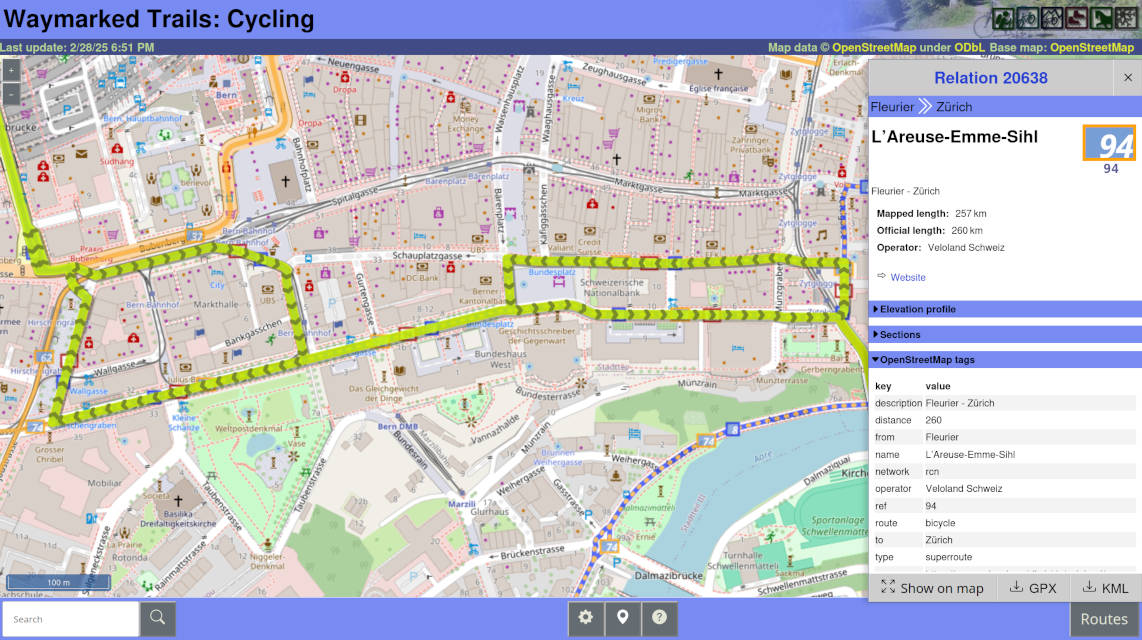
I’ve just rolled out some updates for waymarkedtrails, the website for browsing route relations. The most notable improvement is that waymarkedtrails is finally able to understand member roles in route relations. This post gives a quick overview of what works and what doesn’t and what has changed with in the route views.

Forward/backward roles

The first group of roles handled specially are forward and backward roles which indicate that the route follows the given way only in the direction of the way or in counterflow. These oneway sections are now shown when details of a route are displayed:

Route with forward and backward sections

Waymarkedtrails will internally merge forward and backward sections into split sections and count them only once when computing the length of the route. However, this only works, when all ways of such a spilt section appear together in the relation and follow the order of the route. (See also the notes on ordering below.)

Roundabouts

See full entry

OSM History Viewer and OSM Route Manager are two ancient tools that help visualising and analysing changesets and route relations. In particular, they provide the following features: * Show the geographic and tag changes that a specific changeset has caused * Render a route relation (with support for nested relations), detect gaps and inconsistencies, and export the route as GPX * Analyze the history of relation members and show who last edited (and is thus to blame for) which section of the relation.

I have not maintained these services in many years and they frequently crashed or got overloaded. The user experience was also far from great.

I have decided to rewrite the logic of these tools and integrate it into FacilMap. While the don’t particularly fit the use case of FacilMap, the infrastructure (in particularly the UI elements) is there, making it convenient to integrate it there.

So far I have implemented the first functionality, changeset analysis. You can analyze a changeset by typing changeset <id> (for example changeset 6798641) into the search field, or by calling the URL https://facilmap.org/#q=changeset%20<id> (for example https://facilmap.org/#q=changeset%206798641) directly. As opposed to the legacy OSM History Viewer, the analysis and API requests are now entirely performed on the client side.

I will implement the other two features soon. Once done, the old services will be shut down and a redirect will be put in place.

Feel free to report any problems that you come across by writing to me or by creating an issue.

See full entry

Posted by Canyon Runner on 5 March 2025 in English.

Latest Update from Henderson.

All roads, sidewalks and parking lots were traced out. Traced out some of the park details as well. Unfortunately not too many commercial details or bing street side photos are available of this small town, so cant add too much more information such as stop signs, or storefronts.

Openstreetmap of Henderson Nebrasksa

For the next town, ill probably do something in the north north east.

Also, anyone have any updates as to when bing will work in JOSM again?

Location: Henderson, York County, Nebraska, United States

vir: eProstor - Javni vpogled

Dol pod Gojko

  • 2024-12-20: hišne številke 1 - 4 (s soležečimi zgradbami)
  • 2025-02-27: hišne številke 5 - 9 (s soležečimi zgradbami)
  • 2025-03-03: hišne številke 10 - 17 a (s soležečimi zgradbami)
  • 2025-03-04: hišne številke 17 b - 41 (s soležečimi zgradbami)
  • dokončano
Location: Vrhinšek, Dol pod Gojko, Vojnik, 3213, Slovenija