 OpenStreetMap

the arch of September has its feral grip slapped free from the gators grip of October, I’m holding fast to turkeys and dipping my head in the gravy
Users' Diaries
Recent diary entries
Posted by Wendy Achmmad Mustaqim on 3 November 2024 in English.

Year 2016.
Posted by SunshineIDR on 1 November 2024 in English.

I recently had the privilege of attending the State of the Map (SOTM) Nigeria 2024 conference in Ile-Ife, Osun State, and I am deeply grateful for the experience and the opportunities it provided. I was fortunate to receive a partial grant that covered my transportation, accommodation, and meals, allowing me to participate fully, and I am truly appreciative of this support.
The conference, centered around AI-assisted mapping, drone technology, and open geospatial tools for advancing Sustainable Development Goals (SDGs), was an incredible learning experience. The sessions led by professors, doctors, and online hosts highlighted the potential of these technologies in addressing real-world challenges.
I am especially thankful to Dr. Victor Sunday, the National Coordinator of Unique Mappers Network, for his encouragement and support in making this experience possible. The distinguished speakers greatly enriched the conference. Prof. Kamorudeen Folorunso Aleem kicked off the event with an insightful session on Open Geospatial, AI Technologies, and Geospatial Data Policies in Nigeria, which set the stage for critical discussions on data governance. Prof. Lazarus Mustapha Ojigi, the Executive Director/Professor of Geomatics at the African Regional Institute for Geospatial Information Science & Technology (AFRIGIST), shared his expertise on Artificial Intelligence-Assisted Geospatial Mapping and Modelling Techniques for Achieving Sustainable Development Goals in Africa, providing valuable insights into the integration of AI in geospatial analysis.

Cashless payments have increased dramatically lately, specially during the COVID-19 “main years”. Still, paying in cash can be crucial as a resilience method (think internet, power, banking system outages). It can be used as a great tool to slightly improve privacy. Paying in cash at a cashier usually is an option, but machines handling cash could be preferable, for example:
- Elderly people might prefer a machine handling their coins as opposed to trying to count them themselves.
- People who prefer reduced social contact.
- Cash/coin enthusiasts who prefer cash payments.
Tag payment:cash:machine is suggested to map the status here. Possible values:
- no - All cash handling happens by humans only.
- yes - Machines are available for cash handling.
- cashier - Machines are available for cash handling at cashiers (often limited to coins).
- self-service - Machines are available for cash handling at self-service stations.
Currently mapped objects in Latvia - where green indicates a present cash machine, orange - explicitly tagged “no”.

The State of the Map Nigeria Conference was indeed a unique one. Packed with a lot of excitement. When I said it was fun I really mean it. All the guest speakers both online and in person did very well and I personally learnt a lot from the conference. The conference was held from 8th to 11st of October 2024.

®(Antlaşma,neden,olur,ve,yönetici,kim?) [[User:Jobeyub|Jobeyub]]
Posted by TheFighter137 on 31 October 2024 in English.
Last updated on 1 November 2024.

I definitely seem to love this website. Afterall, it allows me to add some facilities thanks to data provided by french government services : electricity substations, monuments, post boxes, various problems, …
For today, the main municipalities I worked on with OsmOse are Paluel, Néville, Cailleville, Angiens, Cany-Barville, etc… . I also fixed merged adresses and shops so that data is associated accordingly. I started to fix issues in the Rouen metropolis as well, however it will take a few days to finish the whole city considering its size.
Little announcement : I plan to set sort of a weekly schedule to the tasks I want to do. This way, each day of the week will be dedicated to one task in particular, and will have a special name ; for example, SamedInspector (for non-french speakers, it means that saturday would be dedicated to OSM Inspector). Also, even though I will have a weekly schedule, I will switch from 1 entry/day to 1 entry/week that will contain everything I’ve done within the last 7 days.
In Part 3 I talked about changes in POI data in a small area over a period of two months. Most of those changes were due to mapping activity, rather than anything that happened in the real world over that period. But I’d like to use a similar approach to better understand how the real-world POIs are evolving.
As I mentioned in Part 3, until recently a significant proportion of POIs in this area had never been mapped in OSM. That means there is no point in the past at which OSM data is anywhere close to a complete set of POIs for this area. But we might be able to learn something from the POIs that were mapped some time ago.
I chose to look back 5 years, to August 2019. I guessed that was roughly the point at which the data was most accurate. Most POIs were added in 2017-2018, so while lots of POIs were missing, those existing in 2019 were probably still fairly accurate. This is how those specific POIs evolved over 5 years, ignoring anything newly created over that period:
| POI count | as % | |
|---|---|---|
| no major change | 135 | 57% |
| removed | 42 | 18% |
| changed POI type | 38 | 16% |
| changed name | 22 | 9% |
| total | 237 | 100% |
Posted by Calvin Menttor on 31 October 2024 in English.
Last updated on 3 January 2025.

 …and suddenly, I woke up early in the morning just to realize that I was in Lagos on 8th October. Ask yourself what brought me here? Hehehehe… Of course, State of the Map Nigeria Conference 2024. Well, well, my journey was tiring but adventurous as well. Now, let’s double our steps to catch up with other activities. It’s a movie. Oh, sorry, it’s a story. You might need a glass of chilled water. Probably!
Welcome to Nigeria!
As I mentioned in Parts 1 and 2, over the last couple of months I set out to systematically update Points of Interest in four adjoining barrios in the city of Málaga.
A few businesses really did open, close, or change hands over that short period. But the vast majority of the changes in the data reflect the OSM data “catching up” with reality: adding points that had never been mapped in OSM, or updating POIs that had changed in some way since they were last touched by an OSM mapper.
Adding leisure POIs
Closely examining changes over a period is a good way of revealing faulty assumptions. I noticed that three shop locations had disappeared from my data, even though I was sure there were still businesses at those addresses. They are all gyms now, and gyms are tagged as “leisure” - a tag I had completely ignored. I’ve now added leisure POIs. As with “amenity” tags, I excluded some high-volume tags such as “garden” and “swimming pool”. I now have 392 POIs in my current dataset, not 376 as I mentioned in previous diary entries.
Changes over the period
| POI count | count distinct feature tags | |
|---|---|---|
| mid Aug 2024 | 267 | 96 |
| + newly created | 141 | 34 |
| - removed | (16) | (9) |
| late Oct 2024 | 392 | 121 |
| % change | +47% | +26% |
I mentioned in a previous post that I thought that POIs were reasonably well mapped in this neighbourhood. The numbers suggest that about two thirds of POIs were mapped two months ago. That seems respectable, but not great. There has not been any major expansion of retail space in this area recently. Some of the new additions are locations that were vacant or derelict when the area was first mapped in detail, but the majority have existed for a long time and were simply never mapped in OSM.
Posted by Carlos Lunna on 31 October 2024 in Brazilian Portuguese (Português do Brasil).

Este é o nono entre os diários de campo que compõem o caderno de campo da minha pesquisa sobre interações sociotécnicas nos Altos e Córregos da Zona Norte do Recife e sua área contígua em Olinda, cidades localizadas na Região Metropolitana do Recife (RMR). Mais detalhes sobre a pesquisa vocês podem ver na minha tese de doutorado, publicada em https://repositorio.ufpe.br/handle/123456789/48802. Para a tese a delimitação socioespacial foram os Altos e Córregos da Zona Norte do Recife, a parte de Olinda foi agregada depois da tese.
Os diários de campo foram realizados em minhas idas ao território objeto de estudo. Nessas idas sempre registrei o percurso com o aplicativo OSM Tracker. Este é o track da minha ida ao Alto Santa Terezinha, Recife/PE, em 23/04/2024 http://u.osmfr.org/m/1060051/

Este é o oitavo entre os diários de campo que compõem o caderno de campo da minha pesquisa sobre interações sociotécnicas nos Altos e Córregos da Zona Norte do Recife e sua área contígua em Olinda, cidades localizadas na Região Metropolitana do Recife (RMR). Mais detalhes sobre a pesquisa vocês podem ver na minha tese de doutorado, publicada em https://repositorio.ufpe.br/handle/123456789/48802. Para a tese a delimitação socioespacial foram os Altos e Córregos da Zona Norte do Recife, a parte de Olinda foi agregada depois da tese.
Os diários de campo foram realizados em minhas idas ao território objeto de estudo. Nessas idas sempre registrei o percurso com o aplicativo OSM Tracker. No dia 03/10/2023 fui para o Alto do Rosário. Dessa vez não fui por demanda do meu projeto de pesquisa nos Altos e Córregos da Zona Norte do Recife e área contígua de Olinda. Mesmo assim, resolvi ligar o aplicativo OSM Tracker para o registro e fazer algumas observações. Pude fazer um percurso longo dentro da minha área de interesse, pois na ida fui por Recife e voltei por Olinda http://u.osmfr.org/m/968423/
Posted by Carlos Lunna on 31 October 2024 in Brazilian Portuguese (Português do Brasil).
Este é o sétimo entre os diários de campo que compõem o caderno de campo da minha pesquisa sobre interações sociotécnicas nos Altos e Córregos da Zona Norte do Recife e sua área contígua em Olinda, cidades localizadas na Região Metropolitana do Recife (RMR). Mais detalhes sobre a pesquisa vocês podem ver na minha tese de doutorado, publicada em https://repositorio.ufpe.br/handle/123456789/48802. Para a tese a delimitação socioespacial foram os Altos e Córregos da Zona Norte do Recife, a parte de Olinda foi agregada depois da tese.
Os diários de campo foram realizados em minhas idas ao território objeto de estudo. Nessas idas sempre registrei o percurso com o aplicativo OSM Tracker. Esse diário diz repeito a ida para o Córrego do Abacaxi - Alto da Macaíba - Alto da Bondade - Alto da Sucupira, Olinda/PE, em 30/05/2023. Neste link, na camada de linhas na cor indigo, está o registro do percurso realizado no dia http://u.osmfr.org/m/922236/

Posted by TheFighter137 on 30 October 2024 in English.
Last updated on 1 November 2024.
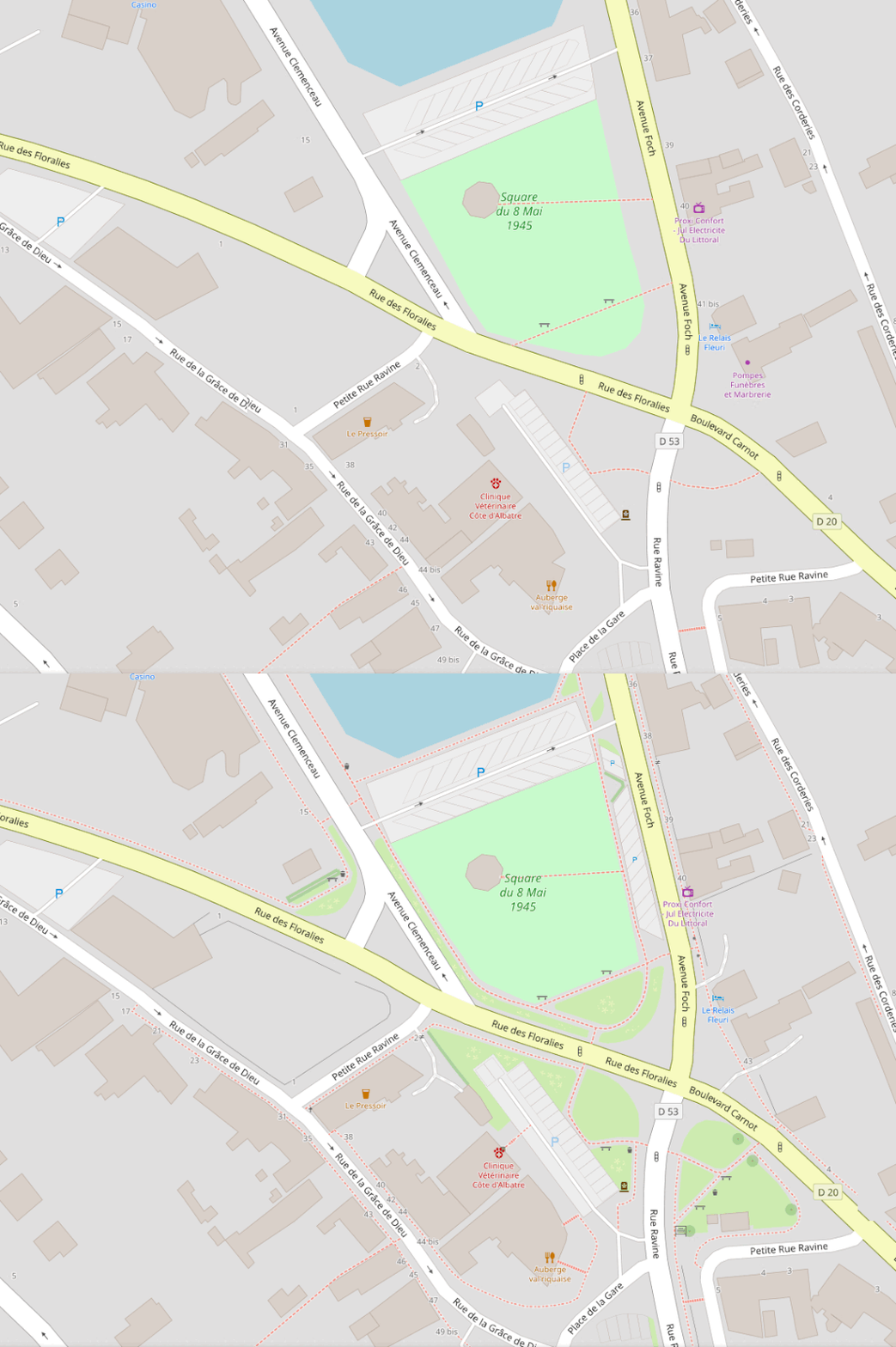
This is the first time I try micromapping in OSM. It took quite a while to learn the appropriate tags for some amenities, but I got there in the end. For a first, I decided to focus on an open area I know very well, which is a square in my hometown. I didn’t do much in terms of area coverage, but it is still pretty noticeable. By the way, if you want to check if I’ve done my job correctly, please note that less than one year ago, all hedges and trees that surrounded the square were torn down ; no idea why considering it looked awesome, now it is pretty dull and flat.
Here’s what it looks like, and considering how it is rendered, I can’t resist feeling proud :
Posted by TheFighter137 on 30 October 2024 in English.
It seems that I tend to forget to publish my daily diary entry on time ; I’ll do my best to do so, even for light workloads
Yesterday, I rode my bicycle to check on-site issues that I noticed with addresses in Saint-Valery-en-Caux. I managed to fix them all, and to map a few fire hydrants as well.
I wish to thank the OsmAnd team for their app : this diary entry was possible thanks to them and their app. Features such as audio/video notes and offline OSM notes were very helpful during this bicycle ride.
Posted by Carlos Lunna on 30 October 2024 in Brazilian Portuguese (Português do Brasil).
Este é o sexto entre os diários de campo que compõem o caderno de campo da minha pesquisa sobre interações sociotécnicas nos Altos e Córregos da Zona Norte do Recife e sua área contígua em Olinda, cidades localizadas na Região Metropolitana do Recife (RMR). Mais detalhes sobre a pesquisa vocês podem ver na minha tese de doutorado, publicada em https://repositorio.ufpe.br/handle/123456789/48802. Para a tese a delimitação socioespacial foram os Altos e Córregos da Zona Norte do Recife, a parte de Olinda foi agregada depois da tese.
Os diários de campo foram realizados em minhas idas ao território objeto de estudo. Nessas idas sempre registrei o percurso com o aplicativo OSM Tracker. Esse diário diz repeito a ida para o Alto do Eucalipto, no bairro do Vasco da Gama, Recife/PE, em 13/04/2023

Posted by Carlos Lunna on 29 October 2024 in Brazilian Portuguese (Português do Brasil).
Este é o quinto entre os diários de campo que compõem o caderno de campo da minha pesquisa sobre interações sociotécnicas nos Altos e Córregos da Zona Norte do Recife e sua área contígua em Olinda, cidades localizadas na Região Metropolitana do Recife (RMR). Mais detalhes sobre a pesquisa vocês podem ver na minha tese de doutorado, publicada em https://repositorio.ufpe.br/handle/123456789/48802. Para a tese a delimitação socioespacial foram os Altos e Córregos da Zona Norte do Recife, a parte de Olinda foi agregada depois da tese.
Os diários de campo foram realizados em minhas idas ao território objeto de estudo. Nessas idas sempre registrei o percurso com o aplicativo OSM Tracker. Esse diário diz repeito a ida para o Alto do Eucalipto, no bairro do Vasco da Gama, Recife/PE http://u.osmfr.org/m/853346/.
Na tarde do dia 05/01/2023, fomos ao Alto do Eucalipto, no bairro do Vasco da Gama, Zona Norte do Recife, para observarmos uma mudança em uma das paisagens que registramos para a nossa tese. O local, um passeio, localizado na Rua Camboriú, abrigava uma lixeira construída pelos próprios moradores, a partir de carcaças de duas máquinas de lavar. No momento do registro inicial, dia 09/03/2022, entendemos que aquele era um objeto técnico importante pra ser registrado. No final de 2022, um dos entrevistados morador da localidade, me informou que as lixeiras foram retiradas e em seu lugar o passeio foi requalificado, com estruturas que atendem principalmente o lazer das crianças.
Posted by pedrito1414 on 29 October 2024 in English.

I was putting together some facts and stats* on OpenAerialMap and the open drone imagery it hosts and thought it might be interesting / useful for OSM peeps as a key user group…

In case you don’t know, OpenAerialMap is a platform for making open imagery available to people that need it.

This year the weather has been quite awful in Milan, and Sunday 20th it was raining once again. However, later during the day it was nice and even sunny, so I decided to go for another trip.
This time I planned in advance and went to Villaggio dei giornalisti, an area that was not particularly covered by previous footage. It is an area of architectural interest and particularly nice.
After that, I went back to the Parco Nord, covering more bike paths in the park.
This time I configured the camera correctly to record a time-lapse, getting around 4 GB of videos for a 2h trip, a much more reasonable file size. The battery also lasted longer, more than 2h and could have gone for much longer. I had to end my trip because it was getting dark.
Another thing I learned from the previous time was to use a fitness tracker to track my trip, so now I can see the calories and speed overall, and observe the trip later on Strava. I also could produce a GPX track, but they are already abundant on OSM in this area.
I still have to figure out an effective way to micromap based on these pictures, iD integrates with Mapillary but the interface is a bit cumbersome for large changes, currently I find easier to open another window with the footage only.
Posted by TheFighter137 on 29 October 2024 in English.
Yesterday, I worked on two municipalities : Jumièges and Saint-Valery-en-Caux, the latter being the one in which I live. I used once again the Pifomètre tool to add adresses. However, I don’t think I’ve finished everything in Jumièges, so I’ll have to work on this municipality again today.