OpenStreetMap logo OpenStreetMap

Diary Entries in English

Recent diary entries

Posted by harisont on 3 January 2026 in English.

I’m finally back to mapping after an unplanned 4-month break.

I usually have a casual but relatively consistent approach to mapping: every time I have to go somewhere new and my exact destination isn’t in OSM, I add it once I arrive; if the opening times of a place I visit regularly change, I update them, and so on. As of late, though, this just hasn’t happened. Either map data has become good enough for my everyday needs in Gothenburg, Sweden or I’ve been paying less attention than usual. Probably a little bit of both.

Right now, on the other hand, I’m visiting my family in Agrigento, Italy, and mapping is the perfect holiday activity for me: it can (to some extent) be done without a computer, which is a nice change of pace, and it gives me an excuse to be outisde, enjoy the warm weather and take all the side streets I haven’t explored before or have forgotten about. Plus, there’s so much to do here compared to Gothenburg!

Today I simply went for a walk and answered a bunchn of quick questions on StreetComplete. In the next few days, I want to try something more systematic, like updating information about what’s happening inside each of the buildings of the main street: a lot has changed since I last came. I’m also pondering trying to get one or two family members involved; we’ll see.

Location: Bibirria, Agrigento, Sicily, 92100, Italy
Posted by fghj753 on 2 January 2026 in English. Last updated on 7 January 2026.

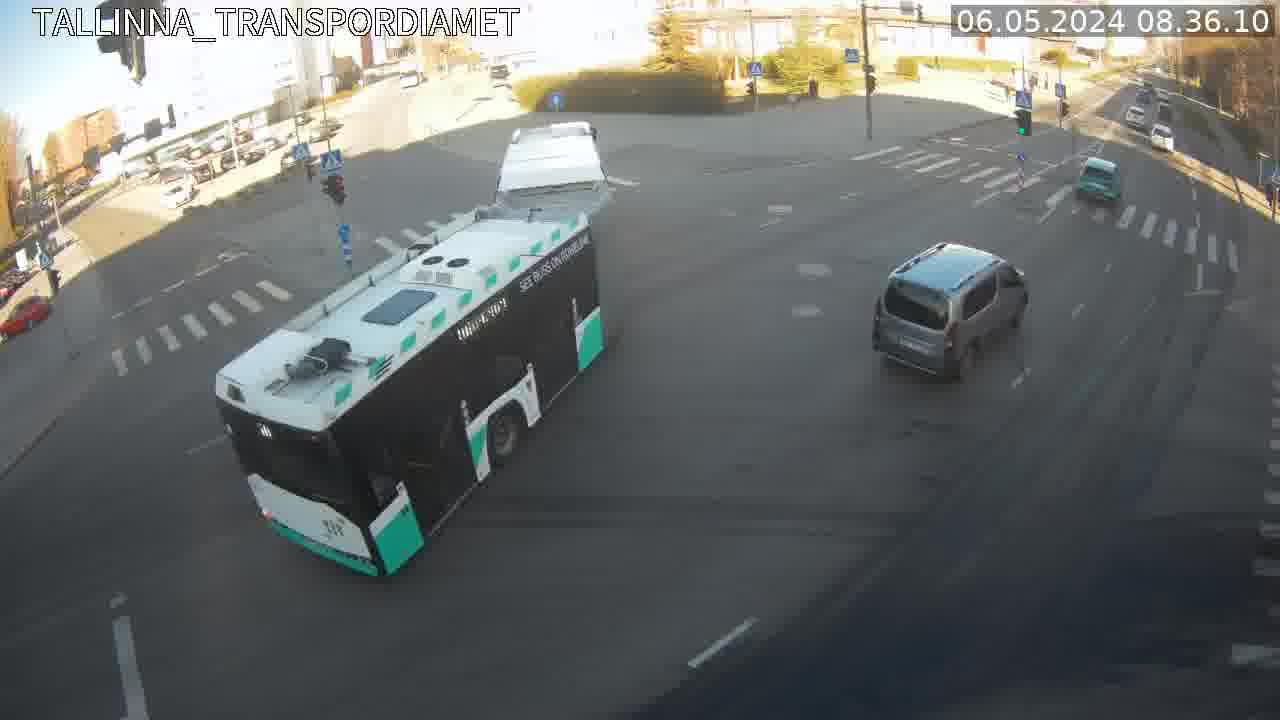
Started this year with a weekend mapping project: locate and map public traffic camera feeds from city’s website. Day 2 and I’m halfway done, about 130 out of ca 260 have live feed links now. Roughly 5 of them weren’t previously mapped at all.

Purpose of this diary entry is to save the checker scipt in publicly accessible place for unlikely reuse. Script scrapes all possible camera IDs and cross references them against already mapped feeds via overpass.

EDIT: Project was mostly completed as of 2026-01-02, changeset/176761784 outlines up to 10 missing cameras yet to be mapped.

sample img

Overpass query to get already mapped ones:

[out:json][timeout:25];
area(id:3600079510)->.searchArea;
node["contact:webcam"~ristm](area.searchArea);
out geom;

See full entry

Location: Pelguranna, Põhja-Tallinna linnaosa, Tallinn, Harju County, Estonia

Thumbnail of the video at commons

Link to the Time Lapse Video of Amaravati (2015-2025)

Time lapse video of OSM has been of interest to me for more than 10 years. I learned to use QGIS in 2015 and made a physical map of Andhra Pradesh in my first attempt. Learning QGIS with its myriad menus and concepts of GIS was daunting to venture further during my infrequent attempts. Finally I made my first time lapse video after 10 years. I found OSM contributor radiotrefoil's diary entry on the subject posted about an year back very helpful. Still I had to struggle to make a good video for OSM edits for Amaravati, the green field capital of bifurcated Andhra Pradesh, a province of India. This is an attempt to document my learnings and make it easier for others.

Choosing an area of interest and fetching data

See full entry

Location: Byrasandra, Bengaluru South City Corporation, Bengaluru, Bangalore South, Bengaluru Urban, Karnataka, India

Last weekend I traveled to the west coast of Java, specifically Anyer in Banten. The journey was done by train from Jakarta to Cilegon, followed by a local shared minivan taxi to Anyer.

Throughout the trip, I collected field observations using Sakumap. The result was a raw GeoJSON file containing coordinates and timestamps for each entry.

For observations I considered significant, I wrote a detailed report on the OSM Wiki. Less critical features such as restaurants, fuel stations, farms, and forest areas were added directly to OpenStreetMap by importing the Sakumap GeoJSON into iD Editor or JOSM, without additional documentation on the wiki, as the overhead did not seem justified.

See full entry

Posted by Syhmac on 31 December 2025 in English.

Hey, this is my first post here and I think it would be fitting if I’d tell all of you why I even created an account here and started making my own edits on OSM.

Background

First, you need to know that I’m a student at Westpomeranian University of Technology in Szczecin in department of computer science. That means that me, and 90% of people there are nerds with interests like: trains, transportation, hacking, programming, opensource and… well… maps.

How it started?

It all started during a normal day at University. We were walking from one building on campus to another when I noticed that my friend has a map open with a lot of pins and some questions on his phone. I asked him what it is and he told me about “Street Complete”. That’s it! I already knew that my ADHD butt found a new hyperfocus for the indefinite amount of time. I installed it and 3 of us started adding the detail information on the map around our campus.

Street Complete era

So… for the next few days I had Street Complete open on my phone during every tram ride and every walk. I wanted to fill every question. This took some time, I answered some question around the Poland in Szczecin, Kielce, and recently in Wałcz.

Taste for more

Right now I’m at my family house in a village where most OSM information where updated several years ago. I went on a walk and - as usual - opened Street Complete. It was great until I came by a few buildings that were demolished few years ago, but were never deleted from the map. I knew that I can’t just leave them there and I couldn’t do this from Street Complete. I went back home and booted my laptop. I opened the OSM editor for the first time and started making edits around the village. Adding houses that were build recently, deleting stuff that no longer existed, updating the zones, etc.

See full entry

Posted by Adrian Shobrooke on 30 December 2025 in English. Last updated on 31 December 2025.

My diary entries are all my own thoughts and do not represent OpenStreetMap, The Humanitarian OpenStreetMap Team (HOT) or any organisation using the HOT systems. Any errors are all my own work.

Back in January 2025 I found myself mapping a HOT project in Kulob, Tajikstan. I had wanted to find a project to gain some experience of mapping water features and this project fit the bill. In support of a local tuberculosis screening programme, Médecins Sans Frontières required the update or addition of roadways, waterways and residential areas. No buildings. This was not a high priority project, so did not get much interest from the general HOT community. Only 11 mappers, with 3 completing tasks. Local mappers would be updating feature and area names. I mapped about 85% of the project, so I have a little stakeholder interest in the data use.

Around the same time I had started attending the Missing Maps London on-line mapathons early in month and mid-month events. As well as getting mapping advice, this put me in touch with the wider HOT mapping community. It turned out that Jorieke, the Kulob project manager, is a regular of the Missing Maps sessions. Along with several of my HOT on-line mapping colleagues, we met at SOTM Europe in Dundee .

Today Jorieke sent me a link to a podcast interview with one of the MSF doctors using the OSM data in Kulob. We rarely get to know about how our mapping supports end users, you can hear it here and discover other mapping related podcasts.

Posted by Evgeny Arbatov on 30 December 2025 in English.

I was visiting Sa Pa, Vietnam, and navigating with Organic Maps. I was looking for a street that would bring me back to the city center. I could not see any on OSM or Google Maps. I walked for a while and was able to see a street that led in the right direction. It turns out that it connected to another street that brought me where I wanted to go. This made me realize how much of the useful information in maps depends on people walking, running, or commuting through those streets. You cannot see these kinds of streets from satellite images. You can only know them, but knowing them, you may not use GPS tracking to record them. I think this leaves only runners and anyone who likes walking to discover most of the streets that are not currently on the map.

Location: Sa Pa, Lào Cai Province, 31786, Vietnam
Posted by ToastHawaii on 29 December 2025 in English. Last updated on 5 January 2026.

Klick hier für Deutsch


Dear OSM Community

The OSM Apps Catalog presents existing apps based on OSM data.

I have plans to redesign the OSM Apps Catalog. In particular, I want to make the landing page and the detailed view of the apps more accessible to a wider audience.

To understand what this needs, I have created a survey. Please fill it out and share your perspective with me. I would be very grateful if you could forward the survey to people who are not particularly interested in technology. This perspective is especially important to me.

Click here for the survey.

Best regards

Markus aka ToastHawaii

Posted by sauce1984 on 29 December 2025 in English. Last updated on 30 December 2025.

dataset column i: A0025A

rel62578,r2613711,r2613712,r2613713,r2613714,r2613715,r2613716,r2613717,r2613718,r2613719,r2613720,r2613721,r2613722,r2613723,r2613724,r2613725,r2613726,r2613727,r2613728,r2613729,r2613730,r2613731,r2613732,r2613733,r2613734,r2613735,r2613736,r2613737,r2613738,r2613739,r2613740,r2613741,r2613742,r2613743,r2613744,r2613745,r2613746,r2613747,r2613748,r2613749,r2613750,r2613751,r2613752,r2613753,r2613754,r2613755,r2613756,r2613757,r2613758,r2613759,r2613760,r2613761,r2613762,r2613763,r2613764,r2613765,r2613766,r2613767,r2613768,r2613769,r2613770,r2613771,r2613772,r2613773,r2613774,r2613775,r2613776,r2613777,r2613778,r2613779,r2613780,r2613781,r2613782,r2613783,r2613784,r2613785,r2613786,r2613787,r2613788,r2613789,r2613790,r2613791,r2613792,r2613793,r2613794,r2613795,r2613796,r2613797,r2613798,r2613800,r2613801,r2613802,r2613803,r2613804,r2613805,r2776569
[out:xml][timeout:25];{{geocodeArea:Köln}}->.searchArea;rel["admin_level"~"6|9|10"](area.searchArea);out meta;

See full entry

Panama Canal Authority–Supported Open Data Initiative

Background and Context

The Los Chorros de Ciri basin, located west of Panama City, is a hydrologically and socially important watershed that supports rural communities while contributing to regional water security. In recognition of this dual importance, the Panama Canal Authority (ACP) funded a high-resolution mapping project focused on community-oriented outcomes and long-term public benefit.

This project represents a shift away from closed, single-purpose GIS deliverables toward open geospatial data that can support community planning, environmental stewardship, and collaborative mapping initiatives.

Project Objectives

The mapping effort was designed around the following goals:

  • Generate high-accuracy base mapping of the Los Chorros de Ciri basin using drone photogrammetry
  • Identify and document community presence within the watershed
  • Release derived GIS products for public and open-source use

Data Acquisition and Processing

Drone Photogrammetry Surveys

Multiple drone missions were conducted in early September 2025, covering discrete but adjacent blocks within the basin. The surveys achieved consistent, high-resolution coverage suitable for both environmental and community-scale mapping.

Key characteristics of the datasets include:

  • Area coverage exceeding 9 square kilometers across all survey blocks
  • Ground sampling distance between 4 and 5 centimeters
  • Full image reconstruction for all flights
  • Dense point clouds exceeding hundreds of millions of points per block

These datasets were processed using WebODM Lightning and generated orthophotos, digital surface models, and digital terrain models suitable for GIS analysis and mapping.

Accuracy and Quality Control

Survey accuracy was evaluated using GPS and 3D error metrics derived during processing. Reported results indicate:

See full entry

Location: Los Chorros o Los Chorritos, Capira, Panamá Oeste, Panama

I am proposing a major initiative to “ratify” and enhance the military fortification data on OpenStreetMap. This project actually began with a very specific personal goal: identifying and submitting newly discovered nodes for the UKBOTA (UK Bunkers On The Air) scheme.

UKBOTA is a fantastic amateur radio award program that encourages the “activation” of historical bunkers and pillboxes. While searching for sites to submit to their database, I realized that while many valid sites exist in specialized archaeological records, our coverage on OSM is often incomplete, misplaced, or lacks the specific metadata (like precise coordinates and typology) required for schemes like UKBOTA. This led me to a broader vision: cross-referencing our map with high-quality datasets—specifically the Extended Defence of Britain (eDoB) database.

The Vision

I have been in discussion with Matt Aldred, the lead developer of the eDoB Online viewer, about bridging his extensive research with our global map. The eDoB database is an evolution of the original Defence of Britain project, offering corrected coordinates, Lidar verification, and specific structural classifications.

By aligning these datasets, we don’t just help the radio community; we create a professional-grade, ratified record of these historical assets for everyone. With tens of thousands of potential nodes to process, doing this entirely by hand would be a nightmare. Therefore, I am proposing a structured bulk import and data enrichment project, conducted in full compliance with the OSM Import Guidelines.

Integration with Wikidata

See full entry

Posted by ottwiz on 28 December 2025 in English.

So it is almost the end of the year, I thought what if I created a summary blog of what I did.

In Hungary: I’m only doing small edits in my neighborhood if some changes happen

Outside of Hungary: Had a small “let’s map Europe” thing, and added forest/farmland land cover/land uses to several countries (Lithuania, Greece, Switzerland, Finland, Germany, Austria, Republic of Cyprus) And also mapped in some U.S. states, main focus on West Virginia (finally finished it after almost 5 years of mapping: June 2020 till Feb 2025 - read diary entry here: osm.org/user/ottwiz/diary/406073) and Pennsylvania, where I clean up the huge multipolygon mess after some users not taking enough care broke a huge 1k sq km big multipolygon.

So this led me to start fixing up. Of course my goal is to map the forest cover of Pennsylvania as much as possible but it’s a way harder task than West Virginia was. Quality-wise, I try to make the quality of it better than it was, so more accurate and more aligns to the imagery than it’s just a roughly drawn something. (Of course if the terrain is rough, i compare the imagery with other services’ available for OSM)

Other than that, I mapped other states a bit as well like Washington, Alaska, Virginia, Texas just to name a few, but not all of them.

I wish you all a Mappy New Year! - Ottwiz

Posted by pussreboots on 27 December 2025 in English.

Today while looking at the hand drawn parcel maps that the county provides I learned the creek that runs through my neighborhood has changed it’s name. On the maps it’s called Sulphur Spring Creek. On all the other maps I’ve seen, road signs, and from what we locals call it, it’s just Sulphur Creek. There’s even a nature center / animal rescue that is named for the creek. They don’t use the spring in their name either.

OK… after getting the comment re sulfurous springs, I did some digging. I haven’t found any historic proof of the claim in this article from last year, but …

“Nestled in the Hayward hills, the Sulphur Creek Nature Center is home to dozens of birds, amphibians, reptiles and mammals, including a coyote and a fox. The site straddles a small section of Sulphur Creek, named after the sulphur water bubbling up from nearby springs. In 1970, H.A.R.D. acquired the property, then a wellness retreat, and transformed it into the animal sanctuary it is today.”

The “spring” part of the creek is shown to be at the current location of the nature center. The other creeks that feed into it have been conflated into all being “Sulphur Creek” I suppose.

https://tricityvoice.com/sulphur-creek-nature-center-completes-renovation/

Location: Fairview, Alameda County, California, 94542, United States
Posted by juminet on 26 December 2025 in English. Last updated on 28 December 2025.

The Belgian OSM community is importing buildings from governmental data into OSM for some years now. In December I was supposed to present a analysis about this process regarding the import of buildings data from the PICC, the source of data for the Walloon region.

Unfortunately I got sick and I could not present. Anyway, here are some key numbers about this process not only for Wallonia but for Belgium.

The big picture

In Belgium, there are 3 different sources of government data for buildings, each one for the 3 regions of Belgium: Flanders, Wallonia, Brussels. All these sources are integrated in what we call the “building import tool”: the web application buildings.osm.be. People who want to use this tool are encouraged to learn about the import process and to conflate (merge) with existing buildings. In many places indeed, there are already buildings in OSM and integration of every single imported building with existing ones is the preferred way, rather than “delete and replace”. We also ask to not blindly trust official data and to always look if current data in OSM does not bring interesting added value in terms of accuracy and/or local knowledge. After all, it is one of the key force of OpenStreetMap.

What are the lessons

Having imported thousands of buildings myself in the past 3 years using this tool, I found some weird situations in the government data: oddities in house numbering, strange shapes of buildings compared to aerial imagery, etc. Honestly, these are very rare situations, but still it might be interesting to report it to the administration. What is more frequent are update of buildings compared to official data: during the import, by comparing with the aerial imagery or local knowledge, one can find some new buildings, or demolished ones, or some changes in the building outline.

For other opinions, see this thread: https://community.openstreetmap.org/t/feedback-about-the-buildings-import-process-for-the-picc/138241

See full entry

Location: Pentagon, Brussels, Brussels-Capital, Belgium